Bentota: Water Sports, Brief Garden & River Safaris
Plan your trip to Bentota - beach resort hotels, water sports, Brief Garden, river safaris, and turtle hatcheries on Sri Lanka's southern coast.
Guides for Bentota
Bentota is a coastal town in Galle District, on Sri Lanka’s southwestern coast, approximately 65km south of Colombo. It is the country’s most established beach resort area, developed since the 1970s primarily for international package tourism. The Bentota River separates the town from the beach lagoon and creates the flat-water bay used for most water sports. The surrounding area - including Aluthgama to the north and Induruwa and Kosgoda to the south - is generally referred to collectively as “the Bentota area” in travel literature, though the specific attractions are spread across a 15km stretch of coast.
Getting here from Colombo takes under 2 hours by train or about 1 hour 20 minutes by car via the Southern Expressway (E01). Most visitors arrive as part of a longer southern coast trip combining Bentota with Galle (58km further south) and Mirissa or Tangalle beyond that. Tours and water sports experiences at Bentota - river safaris, diving, and day excursions - are bookable in advance.
The Beach
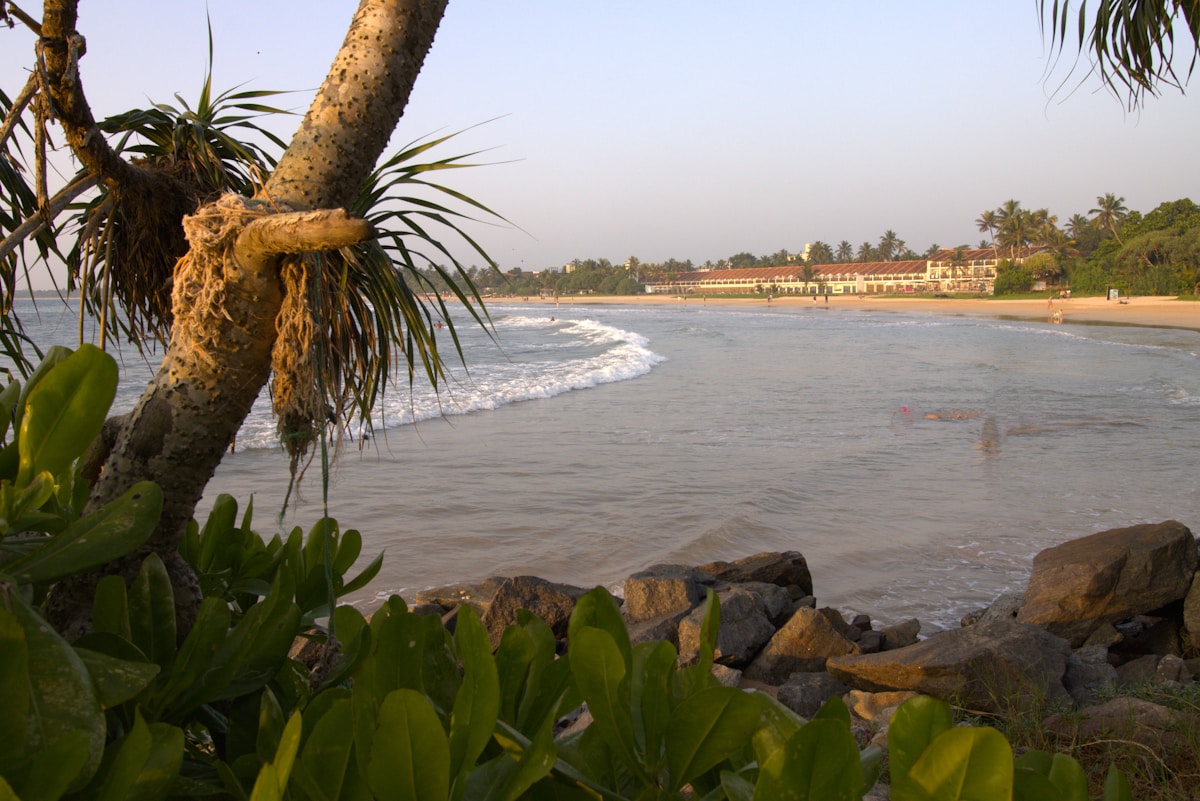
Bentota’s main beach is a 2km arc of sand fronting the Indian Ocean. It runs along the seaward side of the peninsula between the river mouth and the headland hotels to the north. Sand is pale gold, and the beach is wide - wide enough at low tide that you can walk the full length comfortably.
Swimming conditions are good from November to April. The sea is calmer closer to the river mouth. In the southwest monsoon (May to September) the surf builds considerably; beach flags and the advice of your hotel are worth heeding. The beach itself has no entry fee and no formal lifeguard service at most access points.
Beach vendors sell sunscreen, coconut water, and sarongs. The larger hotels maintain cordoned areas in front of their properties; independent access is via gaps between hotel grounds.
Water Sports
Bentota’s water sports industry is concentrated along the river lagoon just inside the beach peninsula. Several operators - including Moana Watersports, Water Sports Bentota, and the facilities at Hotel Serendib and Club Villa - run activities daily from around 8am to 5pm, conditions permitting.
Jet skiing costs approximately LKR 3,000–4,000 for 15 minutes (as of 2026). The lagoon provides enough flat water for beginners; more experienced riders can head toward the river mouth.
Banana boat rides run with 4 to 6 passengers and cost around LKR 1,500–2,500 per person for a 15-minute circuit. They’re towed by speedboat and suitable for most ages.
Water skiing and wakeboarding are available from the established operators; expect to pay LKR 3,500–5,000 for a 15-minute set. Instruction is available for beginners.
Windsurfing equipment is rented by the hour (approximately LKR 2,000–3,000 per hour) and conditions on the lagoon are well suited to learners.
Snorkelling and diving: The water immediately off Bentota beach has limited visibility, but boat trips to the Beruwala reef (about 12km north) are offered by dive schools including Dive Lanka Bentota and Dolphin Dive. A two-tank boat dive costs approximately USD 55–75 (as of 2026). PADI open water courses are available.
Book through your hotel or directly with operators at the lagoon. Negotiate prices in person if you’re combining multiple activities in one session - operators will often discount packages.
Brief Garden
Brief Garden, 5km inland from Bentota town near the village of Beruwela, is the former estate of Bevis Bawa (1909–1992), brother of architect Geoffrey Bawa and a landscape designer in his own right. The 2-hectare garden surrounds his colonial bungalow and was developed over five decades from the 1920s to his death.
The garden is informal and layered - sculptures, lily ponds, stone paths through dense planting, and shaded terraces where Bawa entertained guests including David Lean, who filmed parts of A Bridge Too Far here. The bungalow interior is preserved largely as Bawa left it, with his personal collection of paintings, ceramics, and books visible on guided walkthrough.
Entry: LKR 2,000 per adult, LKR 500 for children (as of 2026). Open daily 8am to 5pm.
Getting there: Tuk-tuks from Bentota town typically ask LKR 600–800 each way. Some hotels arrange day-trip transfers.
Bentota River Safari
The Bentota River flows inland behind the beach peninsula, forming a wide, slow-moving waterway flanked by mangroves, paddy fields, and small villages. Boat safaris last 1.5 to 3 hours depending on the route.
The standard route covers the mangrove channels north of town, where you’ll encounter monitor lizards, water monitors, kingfishers, herons, purple-faced leaf monkeys in the riverside trees, and - on a good morning - estuarine crocodiles sunning on the banks. The river system also passes several small Buddhist temples built on the waterway’s edge, some accessible by dinghy.
Boats depart from the jetty near Bentota town bridge. Organised through most hotels or directly with boatmen at the jetty. Typical cost: LKR 2,500–4,500 per person for a 2-hour morning safari (as of 2026). Prices depend heavily on group size; a private boat for two will cost more per head than joining a shared group.
Go early - 6am to 9am is when bird activity is highest and the light is best. Bring sun protection; the river offers no shade once you leave the mangroves.
Turtle Hatchery
The Kosgoda Sea Turtle Conservation Project, about 8km south of Bentota town near Kosgoda village, runs one of the more established turtle protection operations on the southwest coast. The project has been active since 1981 and focuses on protecting nests on the beach from poaching and commercial disturbance.
The hatchery holds incubating nests relocated from high-risk beach sections, and keeps a small number of juvenile turtles in tanks before sea release. Five species of sea turtle nest on the southern Sri Lanka coast, of which the olive ridley and the green turtle are most commonly seen here.
Entry: approximately LKR 1,000–1,500 per person (as of 2026), with proceeds supporting the conservation programme. Open daily.
Getting there: tuk-tuk from Bentota takes around 20 minutes; ask the driver to wait. Some hotels include a Kosgoda stop as part of a combined river safari and hatchery day trip.
Note: several smaller “turtle hatcheries” operate between Bentota and Kosgoda. Some are legitimate and some are not. The Kosgoda project has the longest operating record and is the most cited by conservation organisations.
Where to Stay
Bentota has a wide spread of accommodation - from large all-inclusive beach hotels to smaller boutique guesthouses inland. Prices below are approximate high-season rates as of 2026.
Taj Bentota Resort & Spa - The flagship property on the Bentota beach peninsula. Rooms start at approximately USD 200–300 per night. Directly on the beach with access to the lagoon, multiple pools, and in-house water sports. Service and facilities match the Taj group standard; the spa is one of the better-regarded on this stretch of coast.
Centara Ceysands Resort & Spa - Set at the point where the river meets the sea, on its own small island accessible by boat from the mainland. Well-designed grounds, multiple pools, and direct beach access. Room rates from approximately USD 120–200 per night. A good mid-range resort pick for beach holidays.
Club Villa - A small boutique property of 10 rooms in a colonial-era villa with a garden, pool, and beach access. Run on a more personal scale than the large resort hotels. Rates from approximately USD 130–180 per night. Popular with European independent travellers; advance booking required in season.
See our full Bentota accommodation guide for more options across all price ranges, with area-by-area advice on where to base yourself.
Search hotels in Bentota on Booking.com
Where to Eat in Bentota
Most eating options concentrate around Aluthgama town (3km north of the peninsula), which has a functioning local restaurant scene separate from the resort hotel dining.
Wunderbar Beach Club - On the beach south of Bentota, open-air setting, fish and seafood grilled to order. Mains from around LKR 1,500–2,500. Informal; the sort of place where people end up spending an afternoon.
The Kingfisher (Aluthgama riverfront) - Seafood-focused, open to non-residents. Good for river views. Mains LKR 1,200–2,500. Strong on local fish such as amberjack and emperor.
The resort hotels (Taj, Centara) have multiple restaurants and are open to non-guests, though prices are notably higher than the local restaurants - expect USD 20–40 per head for dinner.
Getting There
By train: Colombo Fort to Bentota railway station takes 1 hour 45 minutes to 2 hours on an Intercity Express or slower on a stopping train. Bentota station is about 1.5km from the beach hotels; tuk-tuks from the station are LKR 200–400. Trains depart Colombo Fort multiple times daily. Tickets are inexpensive - second class reserved (recommended) costs around LKR 250–400.
By car: Via the Southern Expressway (E01) from Colombo, the drive takes around 1 hour 20 minutes to 1 hour 40 minutes. Exit at Welipenna and continue to Aluthgama/Bentota on the A2 coastal road. Taxis from Colombo city centre cost approximately LKR 5,000–7,000 (as of 2026). From Bandaranaike International Airport: approximately LKR 7,000–9,000, journey time 1 hour 45 minutes to 2 hours 30 minutes depending on traffic.
From Galle or Mirissa: Bentota is 58km north of Galle. Trains run from Galle to Bentota (around 1 hour). By road, the drive takes 45–60 minutes.
Day Trips from Bentota
Galle Fort (58km south) is the most popular day trip: the 17th-century Dutch colonial fortification is a UNESCO World Heritage Site and takes half a day to explore properly. Train is practical - Galle station is a 5-minute tuk-tuk from the fort entrance.
Pinnawala Elephant Orphanage (80km north, via Colombo or via inland B-roads) is reachable as a long day trip but requires a car. Journey time 2–2.5 hours each way.
Hikkaduwa (35km south) for snorkelling on the reef: the coral gardens at Hikkaduwa National Park are among the most accessible reef snorkel sites on the southern coast. Entrance fee approximately LKR 1,500 for the marine national park area; snorkelling equipment rental around LKR 500–800.
Practical Notes
Bentota town proper is small - most services including ATMs, pharmacies, and the main market are in Aluthgama, 3km north. The Aluthgama Friday market is worth a stop if your visit coincides with it.
Mobile data coverage (Dialog, Mobitel) is reliable throughout the area. Most hotels provide Wi-Fi.
Tuk-tuks are the standard way to get between the beach hotels, Aluthgama, and nearby attractions. Negotiate before getting in; a ride within the Bentota/Aluthgama area should cost LKR 200–500 depending on distance.
Book an experience
Top experiences in Bentota
Explore the best tours and activities in Bentota , with instant confirmation and free cancellation on most bookings.
Planning to visit? Browse hotels in Bentota, free cancellation on most bookings.