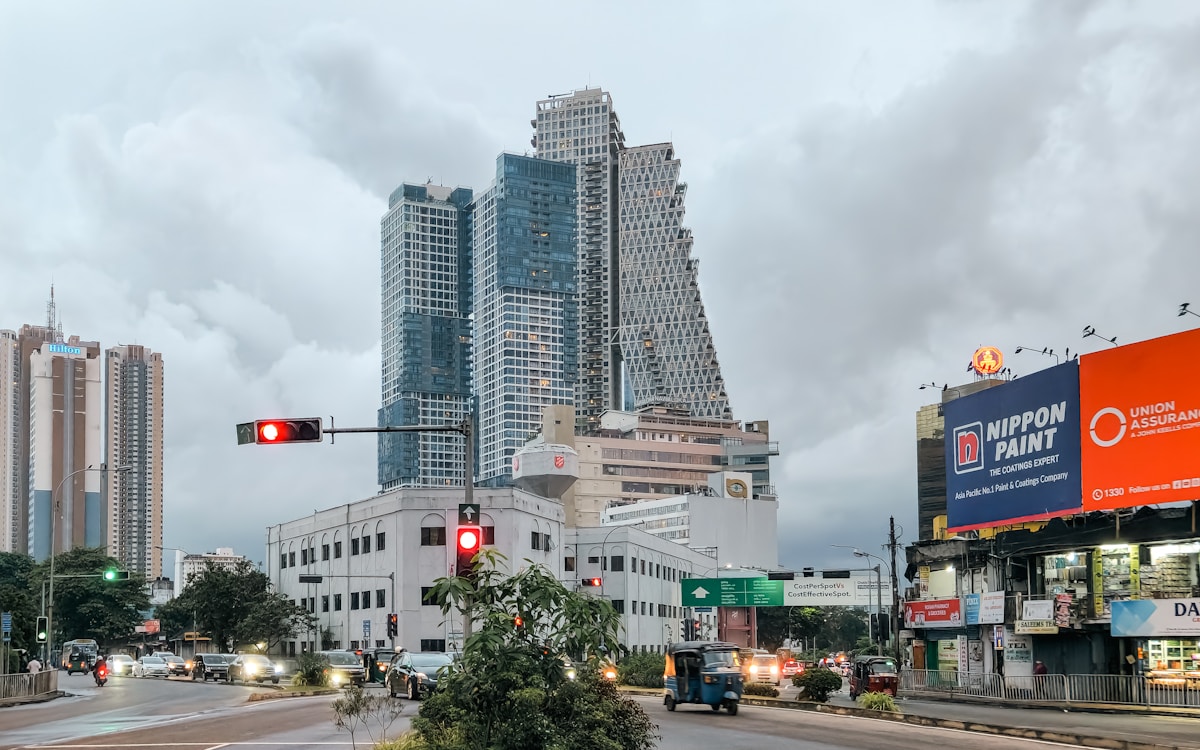
Colombo is not a city built around tourism, which is part of what makes it interesting. Most of its sights are working temples, busy markets, and public spaces used daily by residents. The result is that you see a functioning city rather than a staged version of one.
Most central attractions are within 3–4km of each other. Walking works for short hops in the morning; use a tuk-tuk or Uber for anything further or in the heat of the afternoon.
Gangaramaya Temple
One of Colombo’s most significant Buddhist temples, located beside Beira Lake in Colombo 2. The complex has grown organically over more than a century and now includes a shrine room, a meditation centre, a museum, a library, and a floating island temple (Seema Malaka) on the lake itself.
The museum is a particular draw - it’s an eccentric collection of donated items that ranges from ancient ivory Buddhas and gilded ceremonial robes to luxury cars and vintage motorcycles, all given as offerings over the decades. Entry to the temple grounds is free; the museum costs around LKR 500. The complex is most active on poya (full moon) days when Sri Lankan Buddhists visit in large numbers.
Dress modestly (shoulders and knees covered) and remove shoes before entering any shrine room.
Galle Face Green
A long seafront promenade stretching about 500 metres along the coast in Colombo 3, facing west toward the Indian Ocean. In the evenings this becomes one of the city’s main gathering points - kite flyers, snack vendors selling isso vadei (prawn fritters) and kottu, families, and couples watching the sunset.
The promenade is free and open at all hours, but the evening is the best time to visit. The historic Galle Face Hotel sits at the southern end; its colonial-era terrace bar is worth a stop for a drink regardless of where you’re staying.
Pettah Market
Colombo’s main bazaar district, immediately east of Fort. Pettah is a grid of streets where each block tends to specialise: there are streets for electronics, fabrics, hardware, wholesale groceries, and general goods. The area is primarily functional rather than touristic, and it’s genuinely busy - especially on weekday mornings before noon.
The Jami Ul-Alfar mosque (built 1909, known locally as the “Red Mosque” for its candy-striped facade) sits in the middle of Pettah and is one of Colombo’s most photographed buildings. It’s an active mosque; check visiting hours and dress appropriately.
Best visited: weekday mornings. Quieter on Sundays. Carry a crossbody bag rather than a backpack.
Colombo National Museum
Located in Cinnamon Gardens (Colombo 7), the National Museum occupies a large colonial building dating to 1877. It’s Sri Lanka’s largest museum and has exhibits covering everything from prehistoric artefacts and ancient inscriptions to Kandyan royal regalia, traditional masks, and natural history displays.
The Kandyan throne and royal armoury, removed by the British after 1815, are among the more significant objects on display. The building itself - long colonnaded wings, high ceilings - is worth seeing.
Entry: around LKR 1,500 for foreign visitors. Plan for 1.5–2 hours. Closed on public holidays.
Independence Memorial Hall
A short walk from the National Museum, the Independence Memorial Hall commemorates Sri Lanka’s independence from British rule in 1948. The main hall is modelled on the Audience Hall in Kandy. The surrounding grounds are pleasant to walk through. Entry is free.
Kelaniya Raja Maha Vihara
Located about 15km northeast of central Colombo, Kelaniya is one of the most important Buddhist temples in Sri Lanka. According to tradition the Buddha visited this site during his third visit to the island. The main shrine room has detailed ceiling paintings depicting scenes from the Jataka tales (stories of the Buddha’s previous lives).
Entry is free. It’s busy on poya days and during the Duruthu Perahera festival (January). Allow 45 minutes on site. Best reached by tuk-tuk or Uber - about 30–40 minutes from central Colombo depending on traffic.
Beira Lake Boat Rides
Beira Lake sits between Gangaramaya Temple and the Colombo City Centre mall area. Small rowboats and pedal boats can be hired near the lake’s edge for a short ride on the water. The lake is also home to Seema Malaka, a floating Buddhist meditation pavilion designed by Sri Lanka’s most celebrated architect, Geoffrey Bawa, and accessible by foot across a causeway.
The lake area is pleasant in the early morning before the city heats up.
Viharamahadevi Park
Colombo’s main public park, located in Colombo 7 opposite the National Museum. Named after the mother of King Dutugamunu, the park has large lawns, old trees that provide real shade, and a gold-painted sitting Buddha statue. It’s genuinely used by local families, joggers, and schoolchildren.
Entry is free. Good for a quiet hour between sights.
Old Dutch Hospital
One of the oldest buildings in Colombo, originally a Dutch colonial hospital (17th century), now restored as a restaurant and shopping precinct in the Fort district. The interior courtyard has several restaurants including Ministry of Crab - one of Colombo’s best-known dining destinations. The atmosphere is better in the evening when it’s lit up and tables spill outside.
Colombo Fort Walking Tour
The Fort district, despite being heavily built over, still has a concentration of colonial-era architecture worth seeing on foot. The former GPO building, the Lighthouse Clock Tower (1857), the Dutch Period Museum, the Bank of Ceylon headquarters, and the approach to the Port Gate are all within a 20-minute walk of each other.
Fort is quietest on weekends - which makes walking easier but some buildings are closed. Weekday mornings work well: more activity but more manageable temperatures. A guided city tour of Colombo covers the Fort district, Gangaramaya Temple, and Pettah in a single morning - useful for getting oriented before exploring independently.
Practical Tips
- Start early: most temple and museum visits are best done by 9am before heat and crowds build.
- Colombo 3 and Colombo 7 are walkable if you have sun protection and water. Fort and Pettah are walkable from each other.
- Uber and PickMe both work reliably throughout the city and are usually faster than negotiating a tuk-tuk for longer distances.
- Dress modestly at all temples: covered shoulders and knees. Remove shoes at temple entrances - usually there’s a shoe rack or attendant.
- Most temples have no admission fee to the outer grounds; inner sanctuaries or museums within the complex charge separately.
Planning an overnight? Most visitors base themselves in Colombo 3 (Galle Face) or Colombo 7 (Cinnamon Gardens) for easy access to the main sights. Hotels in Colombo range from budget guesthouses in Pettah to five-star properties on the seafront.
Planning Your Sri Lanka Trip?
- Book tours & activities in Colombo
- Find hotels in Colombo
- Travel insurance for Sri Lanka
- Get a Sri Lanka eSIM
- Find flights to Sri Lanka