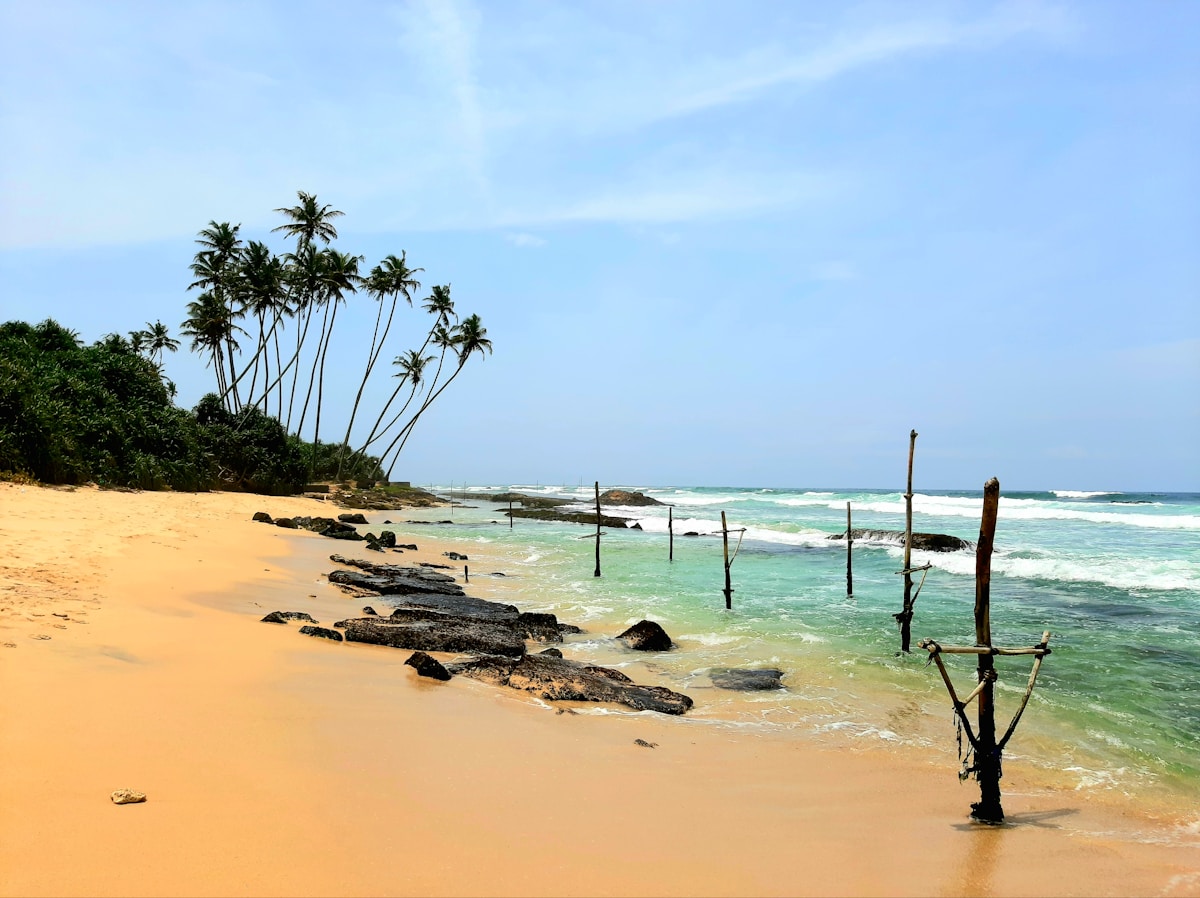
Mannar is a flat, wind-scoured island at the northwestern tip of Sri Lanka, connected to the mainland by causeway and road. The landscape is unlike anything else in the country - dry, low, salt-flat terrain with ancient coastal trees and the Indian Ocean visible in nearly every direction. The Mannar travel guide covers how to get there; this page covers what to do.
The appeal is not beaches, surf, or wildlife parks in the conventional sense. It is an accumulation of unusual experiences - a tree that should not exist here, a fort that has been crumbling for centuries, a geological feature venerated in multiple religious traditions, and one of the more significant bird migration points in South Asia. Visitors who make the effort consistently find it more interesting than expected.
The Baobab Tree
The single most unusual thing in Mannar is a baobab tree estimated to be around 800 years old, growing near the old fort. Baobabs are native to sub-Saharan Africa and Madagascar. Their presence in Mannar - there is a small population on the island, not just one tree - is the result of the Indian Ocean trade networks that connected East Africa, Arabia, and South Asia during the medieval period. Arab traders, who sailed these routes regularly, are credited with bringing baobab seeds. Guided tours of Mannar and the northern Sri Lanka circuit can be arranged in advance.
The tree near the fort is the largest and most accessible. The trunk is several metres in diameter at the base - wide enough that a group of people cannot link hands around it. The canopy spreads wide and the whole structure has the ancient, sculptural quality that makes baobabs remarkable anywhere you encounter them.
Standing next to it and knowing it has been here for 800 years - predating the Portuguese fort visible nearby, predating the Dutch expansion of that fort, having survived two colonial occupations and a civil war - is a more affecting experience than the description suggests. There is no entry fee and no formal access management.
Mannar Fort
The Portuguese built Mannar Fort in 1560. The Dutch expanded and largely rebuilt it in the 17th century - what you see now is predominantly Dutch military architecture, designed as a star fort with bastions positioned to control the sea approach and the causeway.
The outer walls are substantially intact. The interior is another matter: unmanaged and partly overgrown since independence, with government structures of various ages among the colonial ruins. It is not the kind of cleaned-up heritage site where you pay an entrance fee and get a map. It is a large ruin in the process of slow decay.
That is, for many visitors, its appeal. The combination of intact Dutch walls, the baobab nearby, and the fact that essentially nobody else is visiting creates the slightly disorienting atmosphere of a place that has been largely overlooked since the 17th century. Entry is free and informal.
The fort faces the sea and the view from the walls at dusk is excellent - the flat landscape and low horizon make for large sunsets.
Vankalai Sanctuary and Flamingos
The Vankalai Wetland Sanctuary covers a section of Mannar Island’s eastern coastline and the adjacent lagoon - shallow, tidal water with extensive mudflats and salt pans. It is a significant bird migration point on the East Atlantic Flyway.
During the November to January peak migration window, over 150 migratory species pass through, including numerous wader species arriving from breeding grounds across Eurasia and Central Asia - curlews, godwits, sandpipers, stilts. The variety for a serious birdwatcher is substantial.
Flamingos visit the lagoon shallows seasonally. In good years, flocks of several hundred birds can be seen. The timing varies - ask locally when you arrive about current conditions. There is no commercial birdwatching operation at Vankalai; bring your own binoculars and allow at least 2–3 hours for a productive visit.
Access is by road to the sanctuary entrance and then on foot along the waterline. Tuk-tuks from Mannar town reach the sanctuary entrance for approximately LKR 400–600 as of 2026. There are no facilities at the sanctuary itself.
Adam’s Bridge at Talaimannar
Talaimannar is the small settlement at the westernmost tip of Mannar Island, 30km from Mannar town - a tuk-tuk ride of 45–60 minutes. At low tide, the limestone shoals of Adam’s Bridge (Ram Setu in the Hindu Ramayana tradition) are visible stretching toward Rameswaram in Tamil Nadu, approximately 30km across.
In the Ramayana epic, this is the causeway built by the monkey army of Rama to reach Lanka and rescue Sita. The geological reality is a natural formation of shoals and sand bars with some evidence of periods when it formed a land bridge during lower sea levels. The combination of the religious significance and the actual visibility of India across narrow water gives the place an unusual atmosphere.
The settlement itself is minimal - a lighthouse, a few small buildings. Tamil pilgrims visit, particularly at auspicious times. There is nothing else to do at Talaimannar beyond standing at the tip and looking toward India. That is enough.
A tuk-tuk from Mannar town to Talaimannar and back, with waiting time, costs approximately LKR 1,500–2,500 as of 2026.
Practical Notes
- A full day is needed to cover the baobab, fort, Vankalai, and Talaimannar
- The best strategy is: baobab and fort in the morning, Vankalai for birds in the mid-morning, Talaimannar in the afternoon to catch the light on the shoals
- A tuk-tuk hired for the full day in Mannar costs approximately LKR 2,500–4,000 as of 2026 - agree on a total price before departure
- Bring water for the full day; the landscape is dry and exposed, and facilities are minimal
- Binoculars are essential for Vankalai; Mannar town has no hiking equipment shops - bring them from elsewhere
Planning Your Sri Lanka Trip?
- Book tours & activities in Mannar
- Find hotels in Mannar
- Travel insurance for Sri Lanka
- Get a Sri Lanka eSIM
- Find flights to Sri Lanka