Polonnaruwa was Sri Lanka’s second royal capital, at its height from the 10th to the 13th century CE under the rule of kings including Parakramabahu I, who unified the island and oversaw its most significant period of construction. The ruins are better preserved than those at Anuradhapura, more compact, and easier to navigate in a single day. The site is a UNESCO World Heritage Site and one of the most rewarding historical destinations in South Asia. Guided tours of the Polonnaruwa ruins are available for those who want expert commentary on each monument.
The entry ticket ($25 for foreigners) includes access to all monuments and the Polonnaruwa Museum. Visit the museum before walking the ruins - the context it provides makes the site significantly more meaningful.
Polonnaruwa Museum
Located near the main entrance, the museum holds recovered sculpture, architectural fragments, and displays explaining the layout and function of the royal city. Most useful: the scale model showing Polonnaruwa at its 12th-century peak, when it was a city of several hundred thousand people with a working irrigation network and multiple monastery complexes. Allow 30–45 minutes.
Royal Palace Complex
Start here because it’s close to the ticket office and sets the scale for the rest of the visit. The remains of King Parakramabahu I’s royal palace include columns and foundations of a building that originally stood seven storeys high - the foundations span a footprint of 31m x 13m. The adjacent Kumara Pokuna (royal bath) is well preserved.
The Royal Audience Hall is the most elegant surviving structure in the complex - a columned hall with a magnificent carved elephant frieze around the base. The quality of the stone carving here exceeds most of what survives at Anuradhapura and gives a sense of the craftsmanship the 12th-century court commanded.
Vatadage
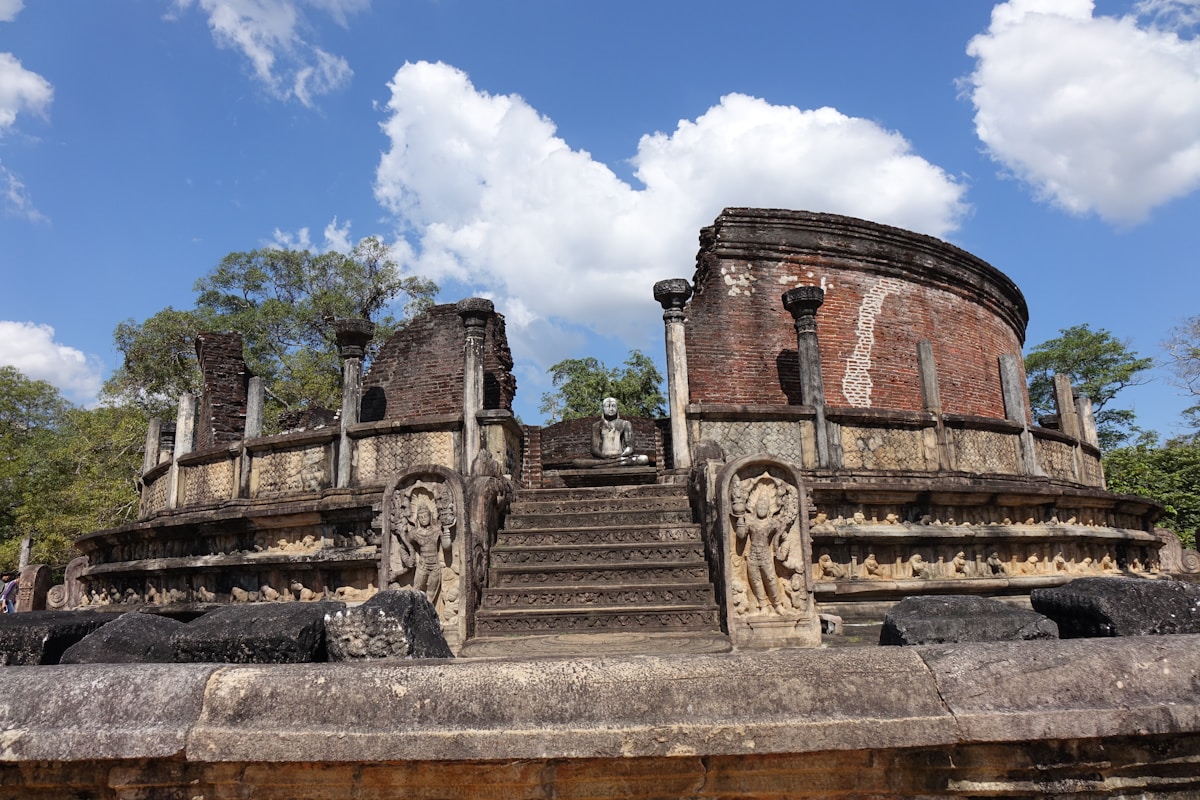
A 10-minute walk north of the palace, the Vatadage (circular relic house) is architecturally the most refined structure in Polonnaruwa. It consists of two concentric stone platforms with a small dagoba at the centre. Four entrances, each facing a cardinal direction, are guarded by fine moonstone threshold stones (floral semicircles in blue stone, among the best examples in Sri Lanka) and carved dvarapala (guardian figures).
Four Buddha figures seated in meditation face outward from the central dagoba toward the cardinal directions. The outer walls carry decorative carvings in excellent condition. Allow 20 minutes and walk the full circuit of both platforms.
Gal Vihara
The pinnacle of Polonnaruwa’s achievement in sculpture - and among the finest surviving examples of ancient Sinhalese stone carving anywhere. Four figures are carved from a single granite face on the hillside: a seated Buddha in meditation (15m wide and 7m high) inside a decorative arch; a smaller seated Buddha in a cave shrine; a standing figure (15m high) with arms crossed in a stance that is sometimes confused with mourning but is in fact a particular meditative posture; and a reclining figure (15m long) depicting the Buddha entering parinirvana - final nirvana at death.
The reclining figure is the most affecting of the four. The sculptor has captured a difference in expression in the face that suggests transcendence rather than sleep. The detail of the robe folds and the cushion beneath the head are carved with precision that still reads clearly 800 years later.
A rope barrier keeps visitors back from the sculptures. Remove shoes at the barrier - the ground between the rope and the rock face is considered sacred. Photography is permitted. Arrive by 9am to see the site without tour groups; by 10am it can be crowded.
Lankathilaka Image House
A 17m-high roofless brick shrine, its walls intact to full height while the roof long since collapsed. Inside stands a headless Buddha in brick - the head is gone, its scale gives an idea of the original statue’s dimensions. The outer walls carry carved decorative niches and figures in reasonable condition. The rooflessness means the interior is open to sky, giving it an unexpectedly dramatic quality. Originally 7 storeys high.
Rankoth Vihara
The fourth largest stupa in Sri Lanka at 55m high. Built by King Nissanka Malla in the late 12th century. Well-restored and surrounded by the ruins of the monastery complex that once enclosed it. Less visited than Gal Vihara but worth the short detour - the scale is significant and pilgrims occasionally circumambulate it in the morning.
Parakrama Samudra
The great irrigation lake built by King Parakramabahu I covers 2,590 hectares and stores 134 million cubic metres of water at capacity. Constructed by linking several smaller earlier tanks, it was the centerpiece of an irrigation system that made Polonnaruwa’s agricultural productivity possible. The lake is still in use today - a 12th-century engineering project that remains functional eight centuries later.
The lake is visible from multiple points along the site road and provides the backdrop for the famous statue of a bearded man carved into a granite outcrop on the western shore - often called “Parakramabahu” though scholars debate whether it depicts the king or a sage. The carving is 4m high and stands alone on a small outcrop beside the road.
Cycling the Site
Bicycle hire is available at the entrance: LKR 200–300 per day. The main monuments are strung along 4km of road north of the ticket office, and the site is flat enough to cycle comfortably. A relaxed cycling tour covering all the major structures takes 4–5 hours including time at each site.
The road through the site is one-way for vehicles but bicycles can go in both directions. There is little shade - bring water, sun protection, and a hat. The mid-afternoon heat (1pm–3pm) is the most punishing; if arriving after midday, start with the furthest monuments and work back.
Practical Information
- Entry ticket: $25 (foreigners), includes museum and all monuments
- Opening hours: 7am to 6pm
- Best time to arrive: 7am (cooler, fewer visitors)
- Time needed: Full day for all major monuments; half day if doing the key sites only (Vatadage, Royal Palace, Gal Vihara)
- Dress code: Cover shoulders and knees at all temple sites; remove shoes at Gal Vihara barrier
- Getting there: Bus from Anuradhapura (2 hrs, LKR 150) or Habarana (45 min, LKR 80). Tuk-tuks available from Polonnaruwa town to the site entrance (2km, LKR 200–300)
- Accommodation: Most visitors base in Polonnaruwa town or Habarana (20km west). Habarana is a useful hub if also visiting Sigiriya (20km north)
Search hotels in Polonnaruwa on Booking.com - compare all options and filter by area, rating, and price.
Planning Your Sri Lanka Trip?
- Book tours & activities in Polonnaruwa
- Find hotels in Polonnaruwa
- Travel insurance for Sri Lanka
- Get a Sri Lanka eSIM
- Find flights to Sri Lanka