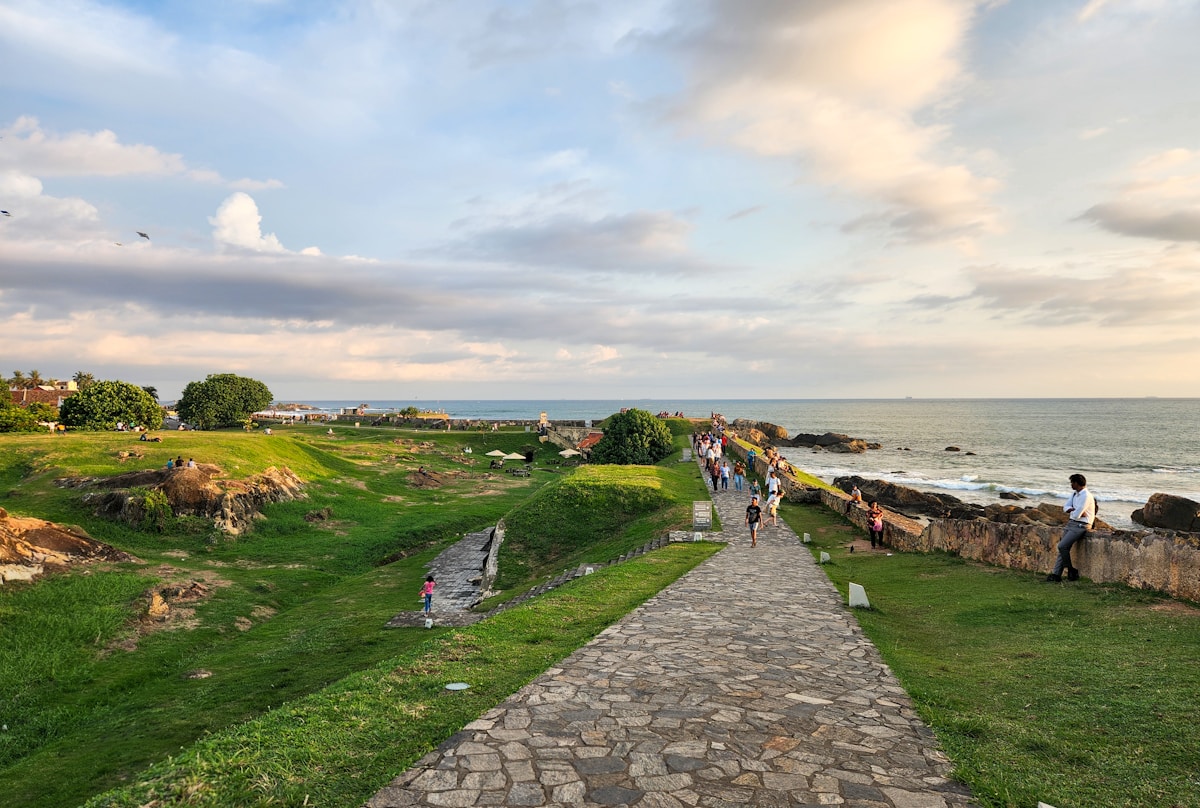
The southern coast from Colombo to Tangalle covers 200km of coastline with five distinct beach towns, each different in character. This 7-night route covers Galle (historic fort and day trips), Mirissa (whale watching and beach), and extends east to Tangalle for a quieter, less-developed experience. Best done November through April when the Indian Ocean on the west and south is calm and whale watching conditions are good. April is the final month before the southwest monsoon arrives - see Sri Lanka in April for transition-month conditions and what to expect at season’s end.
Night 1: Colombo or Negombo (Arrival)
Bandaranaike Airport is 45 minutes from Colombo and 15 minutes from Negombo. A late arrival is easiest in Negombo - several reliable hotels sit close to the airport and Negombo has its own beach and lagoon worth an early-morning walk. If you arrive with time, Colombo’s Fort district and Pettah market are a reasonable half-day.
Night 2: Galle
Take the Southern Expressway from Colombo to Galle - the most efficient road in Sri Lanka at 2 hours from the Kottawa interchange (45 minutes from Colombo city by expressway on-ramp). Private transfer from Colombo to Galle: $40–60. Buses run from Colombo Central (Bastian Mawatha terminal) to Galle via the expressway for LKR 300–400; journey time 2–2.5 hours.
Arrive in the afternoon. Galle Fort is a UNESCO World Heritage Site - a Dutch colonial fortified town built in 1663 on an earlier Portuguese foundation. Walk the ramparts at sunset: the full perimeter is 1.5km and takes 45 minutes at a comfortable pace. To explore the fort’s history in depth, book a Galle tour - local guides cover the Dutch colonial layers and the fort’s architecture far better than walking solo. The lighthouse on the southern tip gives views over the Indian Ocean in both directions. The Fort’s interior is a working neighbourhood of boutique hotels, cafes, art galleries, and government offices occupying Dutch-era buildings with half-moon arches and terracotta roof tiles.
Dinner inside the Fort: the restaurant scene is genuinely good relative to the rest of the south coast. Budget for LKR 2,000–5,000 per person at a Fort restaurant. Search hotels in Galle on Booking.com
Night 3: Galle
A full day in Galle and its immediate area.
Fort morning: The Old Dutch Hospital complex on the ramparts is now an open-air dining and shopping precinct with several separate operators, and a fair place to stop for a drink with sea views. The Galle National Museum (entry LKR 200) is small but covers the Dutch colonial period well. The Amangalla Hotel (19th century, formerly the New Oriental Hotel) serves breakfast and is worth looking inside even if you’re not staying. Walk through the residential lanes where children play outside Dutch-period homes still in family use.
Morning market: The produce market outside the Fort walls near the bus station runs every morning and is worth 30 minutes - jackfruit, mangosteens, rambutan (in season), dried fish, and turmeric root.
Cricket at the Galle International Stadium: Visible from the Fort ramparts, the ground is one of the more picturesque test venues in the world. If a match is on during your visit, day tickets are available and inexpensive - check the Sri Lanka Cricket schedule.
Night 4: Mirissa (via Hikkaduwa)
Take a bus or tuk-tuk 21km west to Hikkaduwa for the morning. The main snorkelling spot is the Hikkaduwa Coral Reef - four resident green sea turtles are reliably present 50–200m from shore, visible by swimming out or taking a short boat ride (LKR 500). Visibility is best in the morning before boats churn the water. Dive schools on the main beach road offer guided dives to local wrecks including the Earl of Shaftesbury (18m, 19th-century British steamer).
In the afternoon, travel east from Hikkaduwa toward Mirissa (65km, 1.5–2 hours by tuk-tuk or bus via Galle). Check in and walk to Coconut Tree Hill at the western end of Mirissa Beach for sunset views along the coast - it’s a 10-minute scramble up a rocky path.
Mirissa is a small beach town that has grown rapidly over the past decade; the main crescent beach has beach bars, sunbeds, and a mix of guesthouses behind it. Quieter than Unawatuna and significantly smaller than Hikkaduwa. Search hotels in Mirissa on Booking.com
Night 5: Mirissa
6am whale watching boat - blue whales (the largest animal ever to have existed) and sperm whales are reliably sighted in the channel south of Mirissa between November and April. The season peaks January–March. Boats depart Mirissa Harbour at 6am and return by noon. Book 2–3 days ahead through your guesthouse or directly at the harbour; most tours cost $30–40 per person. You can also book a Mirissa whale watching or beach tour in advance to secure your spot during peak January–March season. Take seasickness tablets the night before if you’re prone.
Afternoon on Mirissa Beach - the main beach is sheltered and swimmable November–April. Weligama (10km west) has the best surf for beginners on the south coast - several surf schools operate on the main beach and offer 1.5-hour lessons including board for $20–30.
Night 6: Tangalle
The journey east to Tangalle (66km from Mirissa) takes 1.5–2 hours by bus or tuk-tuk. Buses run frequently along the coast road. Tuk-tuk for the full journey: LKR 3,000–5,000 if you don’t want to change at Matara.
Tangalle is markedly quieter than Mirissa or Unawatuna. The main town has a busy fishing harbour and a local market, while the beaches - Medaketiya, Medilla, and Rekawa - are strung out along the coast to the east with fewer tourists and more fishing boats. The sea here can be rougher than the bays to the west; check conditions before swimming.
Rekawa Lagoon is a 15-minute tuk-tuk ride from Tangalle. The lagoon is bordered by forest and has resident crocodiles, water buffalo, and birdlife. Local boat trips available for LKR 1,000–2,000. Search hotels in Tangalle on Booking.com
Night 7: Tangalle (Rekawa Turtle Night)
Rekawa Beach turtle nesting - five species of sea turtle nest on Rekawa Beach, with activity year-round and peaking June–September. The Rukgama Community-Based Turtle Conservation Project runs guided night visits (depart 8pm, minimum 2 hours; LKR 1,500–2,000 per person) - guides monitor the beach and radio ahead when a turtle comes ashore to nest. You watch from a distance in silence with no torches. The conservation project is community-run and the fees support local families who once poached the eggs. Book through your guesthouse in Tangalle.
Day: spend the morning at Hummangala Beach or Medaketiya Beach (broad, relatively empty, backed by palms). Swim cautiously - there can be current at the open ends.
Day 8: Return to Colombo
The Southern Expressway from Matara (22km west of Tangalle) to Colombo takes 2 hours on the road, plus 45–60 minutes through Colombo traffic to the airport. Total from Tangalle: allow 3.5–4 hours. If your flight is tight, leave by 7am.
Private transfer from Tangalle to the airport: $80–100.
Extending East: Yala National Park
From Tangalle, Yala National Park is 50km east (1 hour). Yala has the world’s highest density of wild leopards and also supports sloth bears, elephants, crocodiles, and hundreds of bird species. Entry plus jeep hire: $50–80 per person for a half-day safari. The park is open year-round except when the seasonal closure applies (check dates, typically September or October). Adding 2 nights in Tissamaharama (the base town) fits naturally at the end of the south coast route.
Transport Between Towns
All south coast towns are connected by frequent buses running the coastal highway - the most practical and cheap option at LKR 50–200 per leg. Tuk-tuks are useful for shorter hops (Galle to Unawatuna; Mirissa to Weligama) and cost LKR 300–800. Private transfers make sense for longer hops with luggage. The Southern Expressway significantly speeds up the Colombo–Galle leg but doesn’t serve the coastal towns east of Galle.
Whale Watching Booking Tips
- Book in person at Mirissa Harbour or through your accommodation 2–3 days ahead
- The season runs November–April; blue whales are most reliable January–March
- Most boats carry 30–50 passengers; smaller boats (10–15) cost more but offer a better experience
- Departure time is fixed at 6am - this is non-negotiable as it follows the whale movement patterns
- The trip runs regardless of weather unless conditions are dangerous; rough seas are possible in November–December
- Refunds are rare; credit toward another trip is more common if whales are not sighted (they almost always are)
Accommodation Style by Town
- Galle: Fort hotels (boutique, expensive, $120–300) or guesthouses outside the Fort walls ($30–80)
- Mirissa: beach guesthouses and small hotels ($25–100); few options above $150
- Hikkaduwa: range from surf hostels ($15–25) to mid-range beach hotels ($50–100)
- Tangalle: small family guesthouses ($25–60); a few eco-properties toward Rekawa ($80–150)
Search hotels in Sri Lanka on Booking.com
Cities in This Itinerary
- Colombo Travel Guide
- Galle Travel Guide
- Hikkaduwa Travel Guide
- Mirissa Travel Guide
- Negombo Travel Guide
- Tangalle Travel Guide
- Unawatuna Travel Guide
- Weligama Travel Guide
Activities and Day Trips in This Itinerary
- Whale watching in Mirissa - the centrepiece of this route; book early for January–March
- Snorkelling and diving on the south coast - Hikkaduwa reef and Unawatuna dive sites
- Yala National Park safari - natural extension from Tangalle; 50km east
- Where to stay near Yala (Tissamaharama) - guesthouses, lodges, and luxury tented camps for the safari base
- Sinharaja Forest Reserve - birding day trip from Galle or Unawatuna
- Sri Lanka scenic train routes - the Colombo–Galle–Matara coastal line
- Best beaches on the south coast - comparing all south coast beaches in one guide
Book Your Trip
Flights - search and compare on Aviasales · flights guide eSIM - stay connected with Airalo · eSIM guide Travel insurance - get covered with VisitorsCoverage · insurance guide Airport transfers - book with Kiwitaxi · airport guide Car rental - compare with GetRentaCar Tours and activities - browse GetYourGuide