Search hotels in Kandy on Booking.com
Kandy’s main sights are concentrated in and around the city centre, with the exception of the Peradeniya Botanical Gardens (6km west) and Lankathilaka Temple (a further 10km). The lake and temple area is walkable; tuk-tuks handle everything else efficiently.
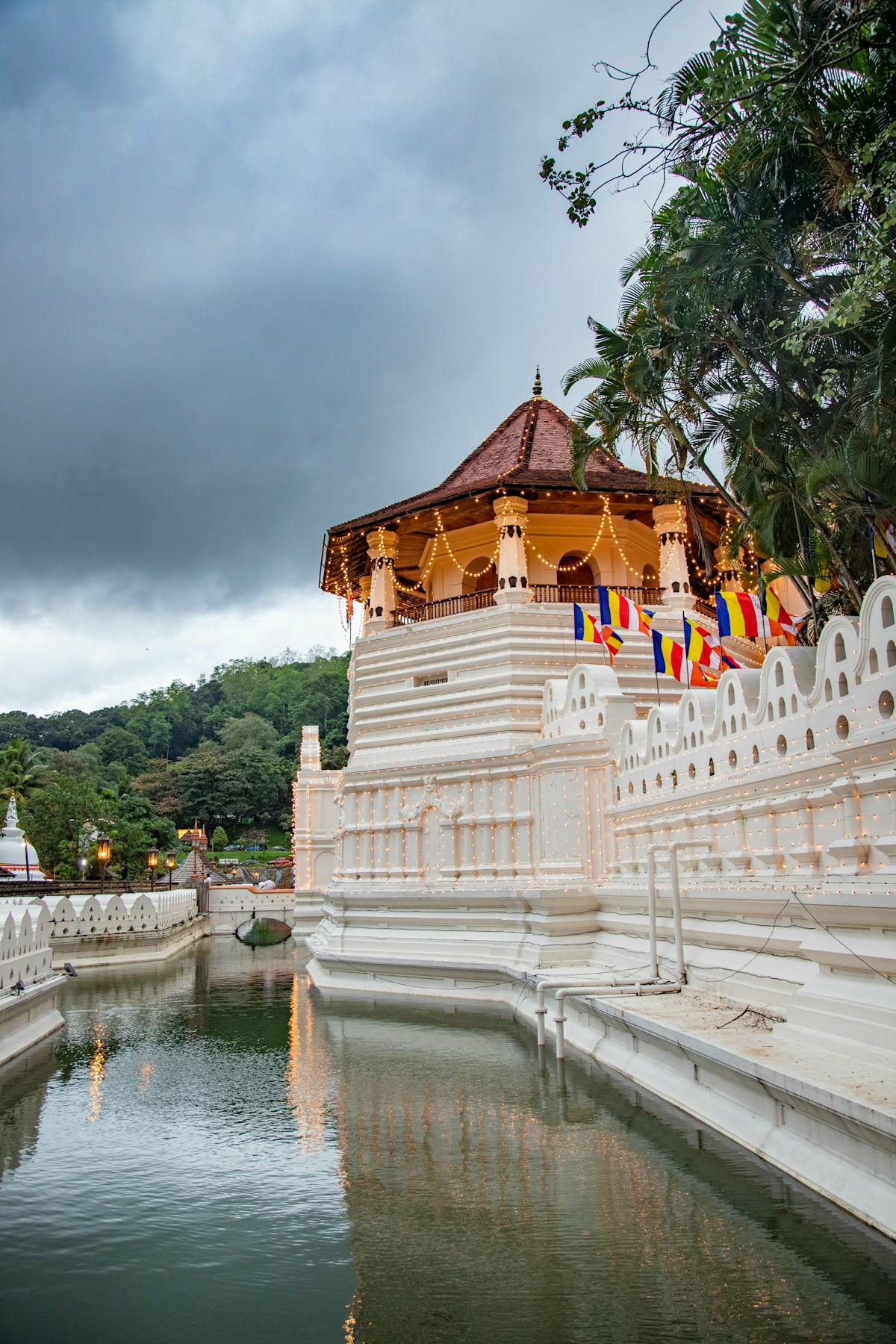
Temple of the Sacred Tooth Relic (Sri Dalada Maligawa)
The single most important site in Kandy and one of the most revered in all of Buddhist Asia. The temple houses what is believed to be a tooth of the Buddha, brought to Sri Lanka from India in the 4th century CE, hidden inside a flower in the hair of a princess. It has been housed in Kandy since the late 16th century.
The puja ceremonies at 5:30am, 9:30am, and 6:30pm are the best times to visit. During puja, the doors of the inner shrine are opened, drummers perform, and devotees queue to make offerings and venerate the casket in which the relic is kept. The atmosphere at the evening puja is particularly striking - incense, drumming, candlelight, and hundreds of worshippers.
The complex includes:
- The inner shrine room - where the casket is kept
- The Audience Hall - a carved wooden royal audience hall with intricate pillars
- The Paththirippuwa (Octagonal Tower) - used to display the relic on processional occasions
- The Alut Maligawa - a newer shrine chamber with a large seated Buddha
- The Archaeological Museum within the complex
Entry: Around LKR 1,500 for foreigners. Dress code: Covered shoulders and knees; remove shoes before entering the inner shrine area. A guided temple and cultural tour in Kandy provides context on the relic’s history and the significance of the puja rituals that is difficult to pick up independently.
Kandy Lake Walk
The lake path runs for about 3km around the perimeter and is one of Kandy’s most pleasant walks. The cloud wall along the northern edge - a low parapet with a coral-tiled top, built by the last Kandyan king - is distinctive. The best times are early morning (mist over the lake is common) and late afternoon.
The path is partially shaded and mostly level. Street food vendors and tea stalls operate near the car park area on the eastern end.
Udawattekele Sanctuary
A forest reserve covering 104 hectares on the hill immediately above and behind the Temple of the Tooth. It was once the royal forest, reserved for the Kandyan court, and entry was forbidden to commoners.
Today it’s open to the public and excellent for birdwatching. Species include the Sri Lanka blue magpie, chestnut-backed owlet, Layard’s parakeet, and various flycatchers and babblers. The canopy is dense and the temperature noticeably cooler than the lake area below.
There are several walking trails. The basic loop takes 45–60 minutes; the full reserve takes a morning. Entry fee is minimal (around LKR 100). Few tourists visit, which is a point in its favour.
Royal Botanical Gardens, Peradeniya
Six kilometres west of Kandy along the Colombo road, the Peradeniya Botanical Gardens occupy 147 acres on a bend in the Mahaweli River, Sri Lanka’s longest. They were developed in their current form by the British from 1821.
Highlights:
- The giant Java fig tree (Ficus benjamina) - a single tree with a canopy spreading roughly 2,500 square metres, supported by aerial roots
- The Avenue of Royal Palms - planted to mark the 1950 royal tour of Ceylon
- The Orchid House - a greenhouse with a large collection of Sri Lankan and tropical orchids
- The Cactus House - a separate greenhouse with succulents and arid-climate specimens
- The spice collection - nutmeg, cinnamon, vanilla, and cloves growing in a labelled garden
Entry: USD $10 for foreigners (paid in LKR at the gate). Open daily 7:30am–5pm. Allow a minimum of 2 hours; 3 hours to see it properly.
National Museum of Kandy
Located next to the Temple of the Tooth in the former Queen’s Palace. The museum focuses on Kandyan cultural history - royal artefacts, Kandyan jewellery, traditional weapons, dance costumes, and documents from the Kandyan Kingdom period. Smaller than the Colombo National Museum but more focused.
Entry: Around LKR 600 for foreigners. Open Tuesday–Sunday 9am–5pm.
Kandyan Dance and Cultural Shows
Evening performances of Kandyan dance are put on specifically for visitors at several venues in the city. The shows typically run 45–60 minutes and include multiple styles of Kandyan dance, Kandyan drumming, plate-spinning, and fire-walking. They’re designed for tourists but the dancing itself is genuine - Kandyan dance is a classical art form and the performers are trained.
Main venues: The Kandyan Arts Association Hall and the YMBA Hall. Shows typically start at 7pm. Cost: Around LKR 1,000–1,500 ($10–15 USD).
Bahiravokanda Vihara (White Buddha Statue)
A large white seated Buddha statue on a hill above the city, visible from many parts of Kandy. The statue is 27 metres tall and was built in 1970. The approach involves a climb up some 300 steps; the reward is a panoramic view of the city and the lake below.
Entry is free. Best visited in the morning or late afternoon when the light is good and the heat is manageable. The hill is directly accessible from the city centre.
Asgiriya Maha Viharaya
One of the two most important monasteries of the Syam Nikaya, the largest chapter of Sri Lankan Buddhism. Located on a hill north of the lake. The painted murals in the shrine room (mostly 19th-century) depict scenes from the Jataka tales. Less visited than the Temple of the Tooth, which gives it a quieter, more contemplative atmosphere.
Lankathilaka Temple (Half-Day Trip)
About 14km southwest of Kandy (30 minutes by tuk-tuk), Lankathilaka is a remarkable 14th-century temple built by King Bhuvanekabahu IV. The brick sanctuary walls rise several storeys, the lower floors housing standing Vishnu and other Hindu deities, the upper floors containing a large seated Buddha image. The roof is partially collapsed, giving the structure a dramatic, partially ruined appearance from the outside.
Combine with Gadaladeniya Temple (1km away) if making the trip.
Practical Information
- Kandy Market: Open mornings in the central market building. Good for fresh fruit, spices (cinnamon, cardamom, pepper), and textiles. Well-priced and genuinely used by locals.
- Getting around: The city centre around the lake and temple is walkable. Tuk-tuks handle everything else: to Udawattekele, Peradeniya Gardens, Bahiravokanda. Negotiate fares before getting in or use Uber.
- Heat: Kandy is cooler than Colombo (typically 24–27°C vs 30–33°C) but still warm midday. Morning visits for outdoor sites are recommended.
- Opening hours: The Temple of the Tooth is open all day but is most active during puja times. Most museums are closed on Mondays or Tuesdays.
Planning Your Sri Lanka Trip?
- Book tours & activities in Kandy
- Find hotels in Kandy
- Travel insurance for Sri Lanka
- Get a Sri Lanka eSIM
- Find flights to Sri Lanka