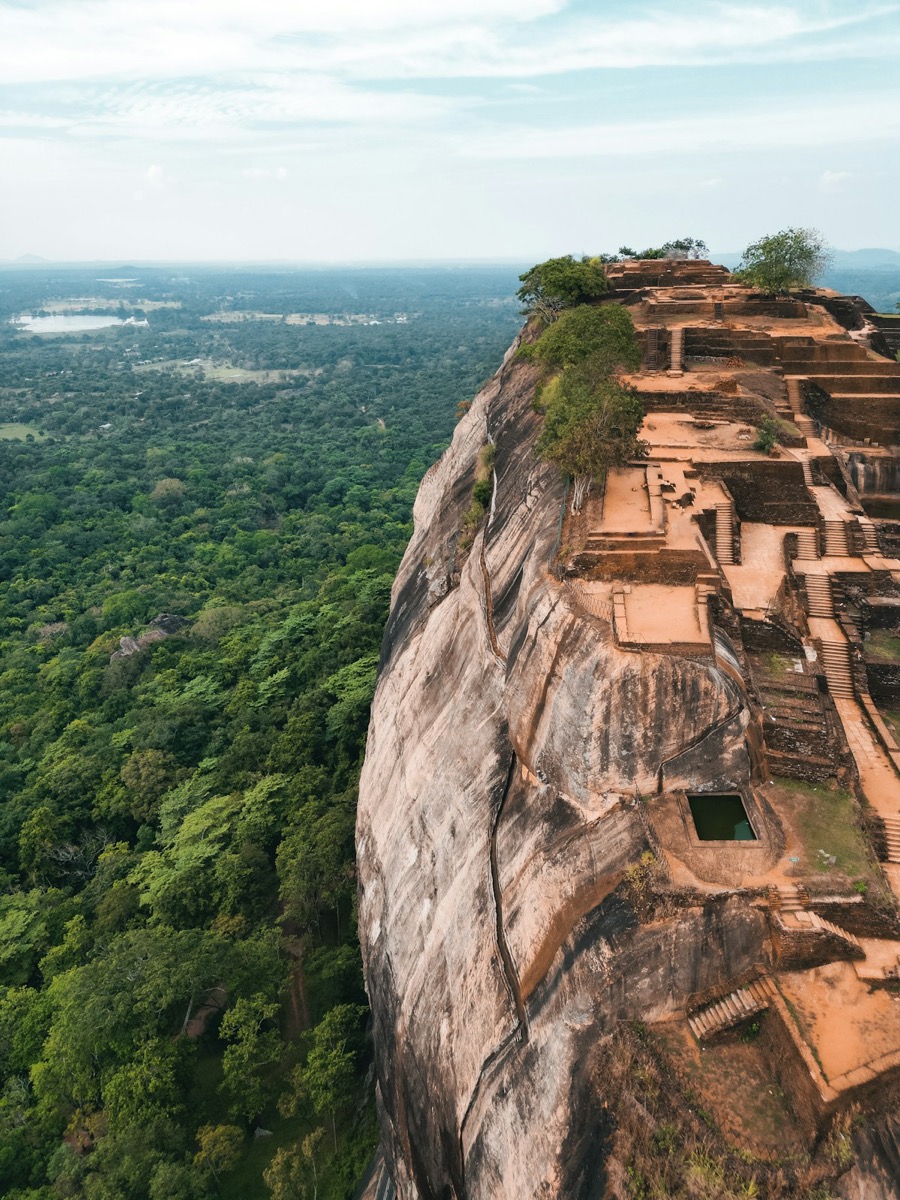
Climbing Sigiriya is the reason most visitors make the journey. The rock rises 180 metres above the surrounding jungle - not a great height in absolute terms, but the ascent route passes through 1,500 years of history: water gardens, ancient frescoes, a mirror-polished plaster wall covered in old inscriptions, and the ruins of a 5th-century palace at the top.
Entry costs USD $35 for foreigners. The site opens at 7am. Allow 2.5–3 hours for a complete visit including the summit. You can buy skip-the-queue entry tickets through Tiqets and book guided Sigiriya tours that combine the climb with Pidurangala or Dambulla in a single day.
The History
King Kasyapa I built his royal capital on top of Sigiriya between 477 and 495 CE. He had killed his father, the previous king Dhatusena, and seized power, knowing his half-brother Mogallana was in India gathering forces for a return.
Kasyapa’s choice of Sigiriya was both defensive and symbolic. The sheer walls of the rock made it nearly impregnable from below. The elaborate palace complex on top, with its polished surfaces, formal water gardens, and painted women visible on the rock face, projected an image of a powerful and cultured court.
In 495 CE, Mogallana returned. Kasyapa met him on the plains below the rock. During the battle his elephant turned away from a swamp; his troops, interpreting this as a signal to retreat, fled. Kasyapa was killed. Mogallana restored the capital to Anuradhapura and gave Sigiriya to the Buddhist sangha (monastic community). Monks used it as a monastery for several centuries before it was abandoned entirely. It was re-discovered by British surveyors in the 19th century and excavated seriously from the 20th century onward.
The Ascent Route
The route from the main entrance to the summit plateau passes through several distinct sections.
The Water Gardens (Base Level)
Before the rock itself, the formal water gardens occupy the approach from the western entrance. These were part of the royal precinct - a symmetrical landscape of pools, fountains, and pavilion platforms extending across several hundred metres.
The fountains are fed by underground stone channels and a hydraulic pressure system that still works during the rainy season. When the water table rises after rain, the fountains push water up without any mechanical assistance - the same principle installed by 5th-century engineers.
The garden also includes boulder gardens (boulders used as platforms for pavilions, the wood long gone) and a terrace garden rising toward the rock face. Allow 15–20 minutes in the water gardens before starting the climb.
The Lower Staircases
Wide brick staircases climb the lower western face of the rock, rising through a series of terraced levels. These are well-maintained and not especially steep. The surrounding jungle is close on both sides; at this level you’re moving through the lower rock garden with boulders and old brick walls visible.
The Fresco Pocket (Halfway Point)
A spiral metal staircase, bolted to the rock face, climbs to an overhang in the western rock where the Sigiriya Damsels frescoes are sheltered. This is one of the most important stops on the ascent.
The frescoes: Of the approximately 500 paintings originally covering this section of the rock (and possibly other parts of the complex), 21 survive in reasonable condition. The paintings show women from the waist up - some holding flowers, some with attendants. They are believed to be either apsaras (celestial beings in Buddhist cosmology) or women of the king’s court. The pigments used included natural ochres, yellows, and lead-based whites, applied to a plaster base that was fixed directly to the rock.
The paintings are protected from rain by the natural overhang above them and have survived with their colours largely intact. The quality of execution - fine line work, naturalistic shading - places them among the best examples of ancient painting in Asia.
Photography policies have varied over the years (flash photography was banned to protect the pigments). Check current rules at the gate.
The Mirror Wall
A stretch of the rock face below the fresco gallery and extending along the walkway to the Lion’s Paw is covered in polished lime plaster - the “mirror wall.” This surface was so finely finished that the king could reportedly see his reflection in it as he walked past.
Over roughly 1,300 years (7th to 14th centuries), visitors wrote on the wall - short poems, impressions of the site, responses to the frescoes above. These inscriptions are among the oldest known examples of Sinhala writing. They cover a range of sentiments: praise for the painted women, reflections on the beauty of the rock, and occasional complaints about the climb.
You can see the inscriptions but must not touch the wall - it’s a protected surface. The texts have been transcribed and translated by Sri Lankan scholars; the Sigiriya Museum at the base has some reproductions.
Lion’s Paw Gateway
At the top of the mirror wall walkway, the route passes between two enormous carved lion paws - all that remains of a lion sculpture that once formed a gateway through the lion’s open mouth to the summit above. The rest of the brick lion has long since collapsed.
The lion paws are approximately 4 metres tall. They mark the symbolic entrance to the royal domain above. Kasyapa used the lion as his dynastic symbol, and the full lion figure would have been visible from the plains below.
The approach to the lion gateway is via metal ladders and steep steps - the most vertiginous section of the climb for those with a fear of heights.
The Summit Plateau
The flat top of Sigiriya covers approximately 1.6 hectares. Here are the remains of Kasyapa’s palace:
- The Royal Palace foundations: Stone platforms and brick walls marking the extent of the main palace building
- Cisterns: Large rock-cut cisterns that still hold water, used to supply the palace during the dry season
- The rock throne: A stone throne seat carved from the living rock, facing north and looking down over the water gardens below
- Terrace gardens: Stone-edged terraced areas where gardens surrounded the palace
- The summit pool: A rock-cut swimming pool near the centre of the plateau
The views from the top extend across jungle, paddy fields, and the distant hills on clear days. Pidurangala Rock is visible to the north. The Minneriya Reservoir glints to the east in clear conditions.
Practical Advice
Fitness Level
Moderate. The climb is steep in sections (particularly the Lion’s Paw approach) but does not require any specialist fitness or climbing ability. The spiral staircases are narrow and become crowded if you arrive mid-morning. People in normal health manage the ascent comfortably. Those with severe vertigo may find the Lion’s Paw section difficult.
What to Bring
- Water: At least 1.5 litres per person. There are no facilities on the rock itself. A small kiosk operates near the base but not at the summit.
- Sun hat and sunscreen: The upper sections of the rock are fully exposed from mid-morning.
- Closed-toe shoes: The summit sections require grip. The rock surface near the paws can be wet and polished. Flip-flops or sandals are not suitable for the upper third of the climb.
- Camera: One of the most photographed sites in Sri Lanka. A wide lens is useful at the summit.
Timing
Best time: 7–9am. At 7am the site opens and the rock is in shade on its western face. Temperatures are manageable and crowds are thin midweek. By 10am the rock heats up significantly and the upper sections become congested with tour groups.
Midweek vs weekend: Sigiriya draws large weekend groups from Colombo, particularly on public holidays. Weekday mornings are noticeably quieter.
Weather: The site is accessible year-round. After heavy rain the staircases and rock surfaces become slippery - factor this into your safety assessment if conditions are wet. The site does not close in rain.
Photography Tips
- The frescoes are best photographed without flash (and flash may not be permitted). Natural light in the morning is adequate.
- The summit view is best in the morning before haze builds. Late afternoon can also give good light if you’re willing to do the climb in heat.
- For external shots of the rock, Pidurangala Rock (700m north) provides the best angle - the full rock with the palace ruins visible against the sky.
- The water gardens photograph well in the early morning with low sun and reflection in the pools.
After the Climb
The descent takes 20–30 minutes and follows the same route. Take care on the staircases - going down is harder on the knees than going up.
After descending, the Sigiriya Museum at the entrance is worth 45–60 minutes. It covers the archaeological history, the hydraulic system, the fresco conservation programme, and reproductions of the mirror wall inscriptions.
Planning Your Sri Lanka Trip?
- Book tours & activities in Sigiriya
- Find hotels in Sigiriya
- Travel insurance for Sri Lanka
- Get a Sri Lanka eSIM
- Find flights to Sri Lanka