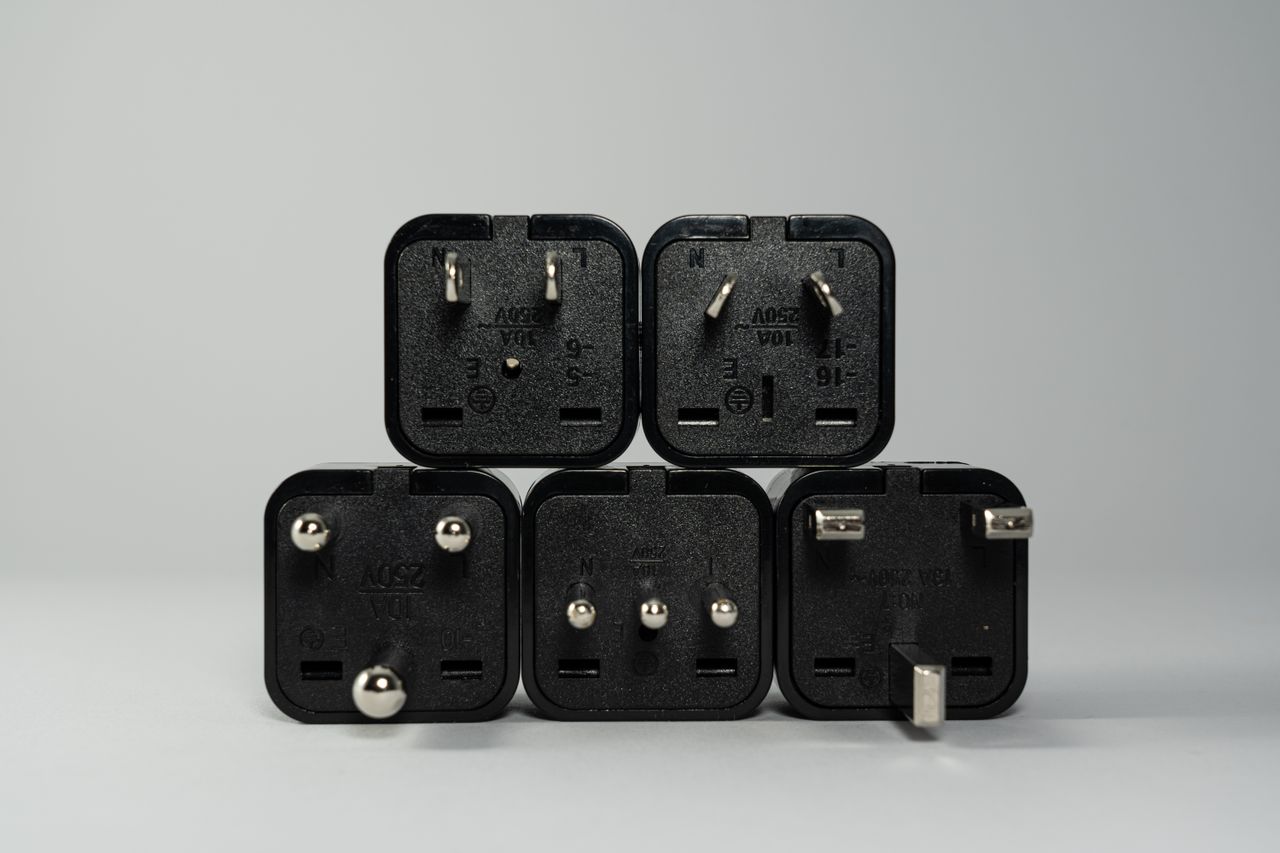
Sri Lanka runs on 230 volts at 50 Hz, the same as the UK, most of Europe, Australia and India. The sockets are the part that trips travellers up, because the island uses a mix of plug standards inherited from different eras. This guide covers which sockets you will meet, which adapter to pack, which of your devices need a closer look, and how to cope when the power drops. For the rest of your kit, see our Sri Lanka packing list.
Plug types you will find
Three socket types are in use, and many outlets are “multi-standard” so more than one plug shape will fit.
| Type | Look | Where you will see it |
|---|---|---|
| Type D | Three round pins in a triangle (small) | Older homes, budget guesthouses, many wall sockets |
| Type G | Three rectangular pins (British style) | Newer hotels, modern Colombo apartments, resorts |
| Type M | Three round pins, larger than D | Occasional use for heavy appliances such as air conditioners |
Sri Lanka’s official standard follows the British Type G, but in practice Type D is still everywhere because so much of the wiring predates the change. Many sockets are a combined design with a larger opening that accepts D, M or G plugs, and in some places a two-pin European (Type C) plug will also slot in, though the fit can be loose and the earth connection is missing.
Which adapter to bring
- Best option: a universal travel adapter. One unit with sliding pins covers Types D, G and M, and it will also work on the rest of your trip if you are combining Sri Lanka with India, the Maldives or Southeast Asia. Pick one with a built-in fuse and at least two USB ports.
- UK travellers: your plugs fit Type G sockets directly. Pack a compact Type D adapter for older guesthouses.
- European travellers: you need an adapter. Two-pin Type C plugs sometimes fit, but do not rely on it.
- US, Canadian and Japanese travellers: you need an adapter and you must check voltage (below).
- Australian and New Zealand travellers: your flat-blade plugs do not fit, so bring a universal adapter.
Pack two adapters rather than one. Guesthouse rooms often have a single working socket near the bed, and a second adapter lets you charge a phone and a camera battery at the same time without a multi-plug extension.
Voltage: when an adapter is not enough
An adapter only changes the shape of the plug. It does nothing about voltage. At 230V, equipment rated only for 110-120V (common for US hair dryers, curling irons and some small kitchen devices) can overheat or burn out.
Check the label on each charger or appliance:
- Phone, tablet, laptop, camera and e-reader chargers: almost always marked “INPUT 100-240V ~ 50/60Hz”. These are fine with just a plug adapter.
- Hair dryers, straighteners, electric shavers, travel kettles: read the label. If it says 110-120V only, leave it at home. Most hotels in Colombo and the main tourist areas provide hair dryers, and cheap 230V ones are sold locally.
- CPAP machines and medical devices: most are dual-voltage, but confirm with the manufacturer before you travel.
Frequency (50 Hz) rarely matters for modern electronics. It can affect old clocks and some motors, which is another reason not to bring older mains-powered gadgets.
Charging on the move
Power sockets are not the limit you might expect, but the sockets are not always where you need them.
- Trains: the scenic hill-country trains, including the Kandy to Ella route, have limited or no charging points in second and third class. Bring a power bank of at least 10,000 mAh. See our scenic train routes guide for planning.
- Tuk-tuks and drivers: a hired car with a driver (see hiring a driver in Sri Lanka) usually has a USB or 12V socket, so a car charger or USB cable is worth carrying.
- Beach guesthouses and eco-lodges: rooms may have just one outlet, sometimes shared with the fan. A short extension lead or multi-way adapter helps.
- Safari days: jeep safaris in Yala or Udawalawe run from early morning, so charge everything the night before and carry a power bank.
Power cuts and surges
Sri Lanka’s grid had a very difficult period with scheduled load-shedding in 2022, and the supply is far more stable now. Short outages still occur, especially during heavy monsoon storms, in the hill country and in remote coastal areas. Voltage can also fluctuate.
Practical habits that help:
- Keep a head torch or phone torch within reach at night.
- Carry a fully charged power bank when you move between guesthouses.
- Unplug laptops during thunderstorms, or use a travel surge protector if you work on the road.
- Ask your guesthouse whether they have a generator or inverter if you need reliable power for work. Our SIM card guide covers keeping a backup data connection while the router is down.
Safety and good sense with sockets
Some older wiring is loose, and plugs can sit at an angle in worn sockets. Do not force a plug into a socket, and avoid running high-draw items such as a travel kettle through a cheap, unfused adapter. If a socket feels hot or sparks, stop using it and tell your host. Trip-related injuries and medical advice are covered in health and safety in Sri Lanka, and travel insurance (see insurance for Sri Lanka) can cover damaged or lost gadgets, depending on your policy.
What to buy and where
If you forget an adapter, Colombo’s electronics shops sell them in the Pettah area and in the larger shopping malls, usually for a few hundred rupees as of 2026, though prices vary. Smaller towns such as Ella or Mirissa have limited stock, so do not plan on buying there. For the most useful rental or booking stops once you land, browse Colombo tours and hotels in Colombo before you arrive, and consider an eSIM for Sri Lanka so your phone works from the moment you land.
Quick checklist
- One universal adapter that covers Types D, G and M (two if you carry several devices)
- A power bank of 10,000 mAh or more
- Dual-voltage chargers only, 100-240V
- A short USB cable and a car charger for long drives
- A head torch for outages
- A small surge protector if you work remotely