Anuradhapura: Sri Lanka's Ancient Sacred Capital
Complete guide to Anuradhapura - the Sri Maha Bodhi, ancient stupas, UNESCO ruins, entry fees, bicycle hire, and how to get there from Colombo.
Guides for Anuradhapura
Overview
Anuradhapura was Sri Lanka’s first great capital. It was established in the 4th century BCE and served as the seat of the Sinhalese kings for over 1,300 years, until it was overrun by South Indian invaders in the late 10th century CE. During its peak it was one of the most important cities in Asia.
Today the ancient city is a UNESCO World Heritage Site and one of Sri Lanka’s most significant pilgrimage destinations. The scale of what was built here is difficult to absorb at first: stupas that were among the largest structures in the ancient world, sophisticated hydraulic systems supplying water across a city of several hundred thousand people, and a sacred fig tree - the Sri Maha Bodhi - that has been continuously tended for more than 2,300 years.
Anuradhapura is located in the North Central Province, approximately 200km from Colombo. The journey takes 4–5 hours by road. It is a full-day site at minimum; most visitors stay one or two nights.
Getting There
By Train
Trains from Colombo Fort to Anuradhapura take about 4–4.5 hours and run several times daily. The intercity express is faster than the slow train; check the Sri Lanka Railways schedule (exprail.lk) for current times. The station is about 1.5km from the sacred city entrance - a tuk-tuk or bicycle ride from most accommodation.
By Bus
Intercity buses from Colombo’s Bastian Mawatha terminal run to Anuradhapura (around 4 hours, LKR 250–350). From Kandy, buses take about 3 hours (LKR 200–300). Buses are frequent.
By Road (Private Vehicle)
From Colombo: take the A9 or the expressway to Kurunegala then north via Dambulla. Around 4–4.5 hours. From Dambulla: 65km north, about 75 minutes. From Sigiriya: around 60km northwest, about 75 minutes.
The Sacred City
The archaeological zone covers a large area - approximately 40 square kilometres in total. The main monuments cluster in the Sacred Precinct to the west and the outer monastery areas. Cycling is by far the most practical way to cover the site: the distances between monuments are 1–5km, flat roads connect them, and bicycle hire is available from most guesthouses and shops near the site entrance for LKR 300–500 per day. Guided tours of the sacred city are a useful option for first-time visitors who want historical context at each monument.
A full-day visit (8am–5pm) is the minimum to see the main monuments seriously. The site is large enough to fill two days if you include the more peripheral monasteries.
Entry: A Cultural Triangle ticket covering all main monuments costs approximately USD $25 for foreigners (prices subject to revision). Individual tickets are also available at some sites. Keep your ticket - it’s checked at multiple points.
Dress code: All monuments in Anuradhapura are active religious sites or are maintained with Buddhist religious significance. Covered shoulders and knees are required throughout the archaeological zone. White clothing is the norm for Sri Lankan pilgrims. You will be turned away in shorts or a sleeveless top at some sites.
Remove shoes at all stupa and temple precincts. The ground can be very hot midday - carry socks.
Major Monuments
Sri Maha Bodhi
The most sacred site in Anuradhapura. A sacred fig tree (Ficus religiosa) grown from a cutting of the original Bodhi tree in Bodh Gaya, India - the tree under which the Buddha attained enlightenment. The cutting was brought to Sri Lanka by Sanghamitta Theri (daughter of Emperor Ashoka) in 249 BCE.
The tree is documented as the oldest living human-planted tree in the world with a verified history. It is now roughly 2,300 years old.
The tree is enclosed within a golden-railed platform with multiple levels. Pilgrims crowd the site constantly - particularly on poya days - offering flowers, incense, and prayer. The atmosphere at the Sri Maha Bodhi is unlike anywhere else in Sri Lanka: it’s a genuinely active, intensely devotional place visited by thousands of Buddhists daily.
Visit: Remove shoes well before the entrance. The innermost platform requires a white garment or at minimum a white covering - sarongs are sometimes available for hire at the entrance. The tree itself is immediately recognisable by its distinctive heart-shaped leaves.
Ruwanwelisaya Stupa
The most visited stupa in Anuradhapura. A massive white dome rising 103 metres, circumscribed by a processional pathway bordered by a wall of elephant statues. The stupa was originally built by King Dutugamunu in the 2nd century BCE and has been destroyed, damaged, and restored multiple times across the centuries.
The current white plaster surface is a modern restoration. The stupa is surrounded by a large open precinct paved in white stone. Pilgrims walk clockwise around the base (pradakshina), making offerings at the four cardinal direction shrines.
Early morning and evening are the most atmospheric times, when the stupa glows white against a blue or orange sky.
Jetavanaramaya
At its original height of approximately 122 metres, the Jetavanaramaya was - briefly - the third tallest structure in the ancient world. Built by King Mahasena in the 3rd century CE. Estimated to contain 93 million fired bricks in its construction.
The stupa is now reduced to about 70 metres (the upper section collapsed) and shows as warm red brick rather than plastered white. The scale remains extraordinary - the base diameter is 113 metres. The Jetavanaramaya Archaeological Museum at the base (included in the site ticket) has artefacts found in and around the stupa during excavation.
Thuparamaya
The oldest stupa in Sri Lanka, built by King Devanampiya Tissa in the 3rd century BCE (247 BCE), shortly after the arrival of Buddhism on the island. It’s much smaller than the later stupas - a compact dagoba shape, 19 metres high - and sees far fewer visitors than Ruwanwelisaya, giving it a quieter atmosphere.
The stupa is ringed by stone columns (the remains of a covered walkway) and sits in a peaceful enclosure. Worth visiting for its age and relative tranquillity.
Isurumuniya Vihara
A rock temple carved into a granite outcrop at the edge of Tissa Wewa lake. The most famous carving here is the “Isurumuniya Lovers” - a relief sculpture of a man and woman seated together, widely reproduced as one of Sri Lanka’s iconic artworks. The style suggests Gupta-period Indian influence (4th–6th century CE).
The temple has additional carvings of an elephant group, a man on horseback, and a royal figure. The setting - carved into cool, shaded rock beside the lake - is pleasant, and the site is much less crowded than the main stupas.
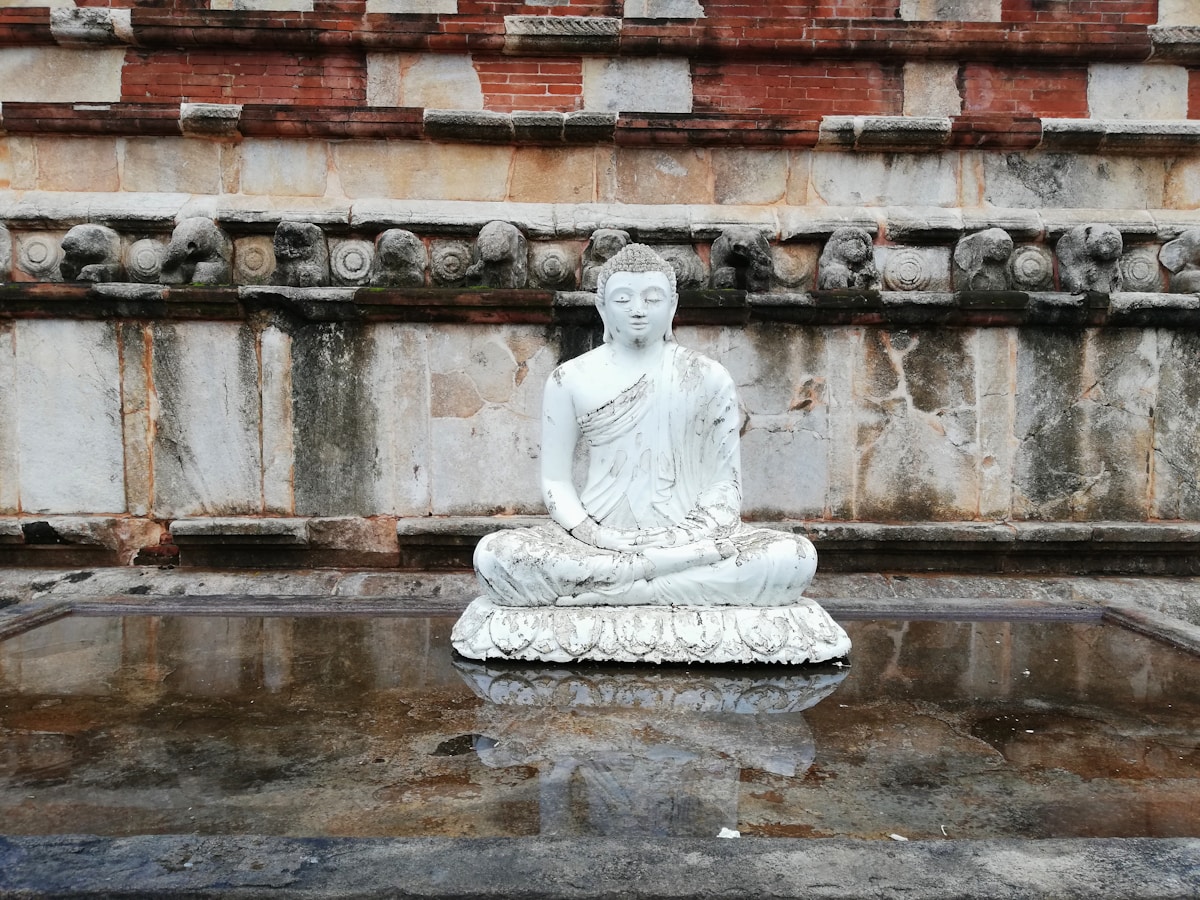
Samadhi Buddha
A 4th-century granite seated Buddha statue discovered during excavation and now displayed in a small garden near the Mahasena Palace ruins. The statue’s expression - a state of deep meditation (samadhi) - is considered among the finest examples of ancient Buddhist sculpture in Sri Lanka. Simple and understated; worth the short detour.
Tissa Wewa
An ancient reservoir immediately south of the main sacred city. Built by Devanampiya Tissa in the 3rd century BCE, it still holds water and is used for irrigation. Cycling around its perimeter is pleasant in the early morning; the lake attracts water birds and the tree line on the far shore gives good light for photography.
Practical Information
- Bicycle hire: LKR 300–500 per day from guesthouses and shops near the site entrance. Essential for covering the archaeological zone.
- Start early: 7–8am. The site is large and exposed. By 11am, heat makes extended cycling uncomfortable. Many monuments have minimal shade.
- Water: Carry at least 2 litres. No facilities between monuments.
- Photography: Allowed throughout; no photography within shrine rooms of active temples.
- Accommodation: The New Town (modern Anuradhapura, east of the archaeological zone) has the widest range of guesthouses and hotels, from LKR 2,500 per night for a basic room to $60–100 for midrange. Book ahead during poya weekends when the city fills with pilgrims.
- Poya days: Full moon days are the most active at all pilgrimage sites. Accommodation is harder to find and sites are more crowded - but the atmosphere at Sri Maha Bodhi and Ruwanwelisaya is particularly intense.
Search hotels in Anuradhapura on Booking.com - compare all options and filter by area, rating, and price.
More in Anuradhapura
Anuradhapura is the northernmost major stop on the Cultural Triangle. From here, Sigiriya is 65km southeast (about 1 hour), and Dambulla is 65km south - the cave temples make a natural addition on the same day heading south. Wilpattu National Park is 30km west of Anuradhapura - Sri Lanka’s largest national park and the least-visited of the major safari parks, known for leopards in a scrub-forest setting. For the wider Cultural Triangle circuit and how Anuradhapura fits the sequence of sites, read the Ancient Ruins guide and the 10-day Cultural Triangle itinerary.
Frequently Asked Questions
- How far is Anuradhapura from Colombo and how do I get there?
- Anuradhapura is approximately 200km from Colombo, taking 4–5 hours by road or train. Trains from Colombo Fort take about 4–4.5 hours and run several times daily. Intercity buses from Bastian Mawatha terminal take around 4 hours.
- How much does entry to Anuradhapura cost?
- A Cultural Triangle ticket covering all main monuments costs approximately USD $25 for foreigners. Keep your ticket - it is checked at multiple points throughout the site.
- What is the dress code for Anuradhapura?
- Covered shoulders and knees are required throughout the archaeological zone. All monuments are active religious sites. White clothing is the norm for Sri Lankan pilgrims. Remove shoes at all stupa and temple precincts - carry socks as the ground can be very hot at midday.
- What is the best way to get around the archaeological zone?
- Cycling is by far the most practical option. Bicycle hire costs LKR 300–500 per day from guesthouses and shops near the site entrance. The roads through the zone are flat and quiet, and a full day covers the major monuments comfortably.
- When is the best time to visit Anuradhapura?
- Start early - by 7–8am. The site is large and exposed, and by 11am the heat makes extended cycling uncomfortable. November to April is the dry season and the most reliable for clear weather. Avoid Poya (full moon) days if you want smaller crowds, though the pilgrimage atmosphere on those days is intense.
- How many days do I need in Anuradhapura?
- One full day covers the main monuments. Two days allows time for the more peripheral monasteries and a relaxed pace. The site is large enough that rushing through it in a few hours leaves most of it unseen.
Book an experience
Top experiences in Anuradhapura
Explore the best tours and activities in Anuradhapura , with instant confirmation and free cancellation on most bookings.
Planning to visit? Browse hotels in Anuradhapura, free cancellation on most bookings.