Anuradhapura’s archaeological zone covers around 40 square kilometres of ancient ruins, reservoirs, monastery complexes, and pilgrimage precincts. The distances between major monuments make cycling the only practical way to cover the site in a day. Hire a bicycle from near the entrance (LKR 300–500 per day) and plan your route before setting out. Guided tours of the Anuradhapura ruins are also available for those who want a structured introduction to the site’s history and iconography.
Below is a monument-by-monument guide to the main sites, with practical detail on what to see and how long each takes.
Starting Point: Sri Maha Bodhi
What it is: The most sacred site in Anuradhapura - a sacred fig tree grown from a cutting of the Bodhi tree in Bodh Gaya, India, under which the Buddha attained enlightenment. The cutting was brought to Sri Lanka in 249 BCE by the nun Sanghamitta Theri, daughter of Emperor Ashoka. The tree has been continuously tended by Buddhist monks since that time. At approximately 2,300 years old, it is the oldest documented living tree planted by a human with a continuous recorded history.
What to expect: The tree is enclosed within an elevated golden-railed platform with multiple levels, surrounded by a large open courtyard. Pilgrims are present at all times - the site never closes. On poya (full moon) days the crowd is immense, with thousands of worshippers offering flowers, incense, and chanting. On ordinary mornings it’s busy but manageable.
Practicalities: Remove shoes before the entrance gate. The innermost platforms require fully covered clothing (white is preferred by pilgrims but not strictly enforced for foreign visitors). Sarongs are sometimes available for hire at the entrance. Photography is permitted in the outer courtyard. Maintain quiet inside the precinct.
Time: 30–45 minutes.
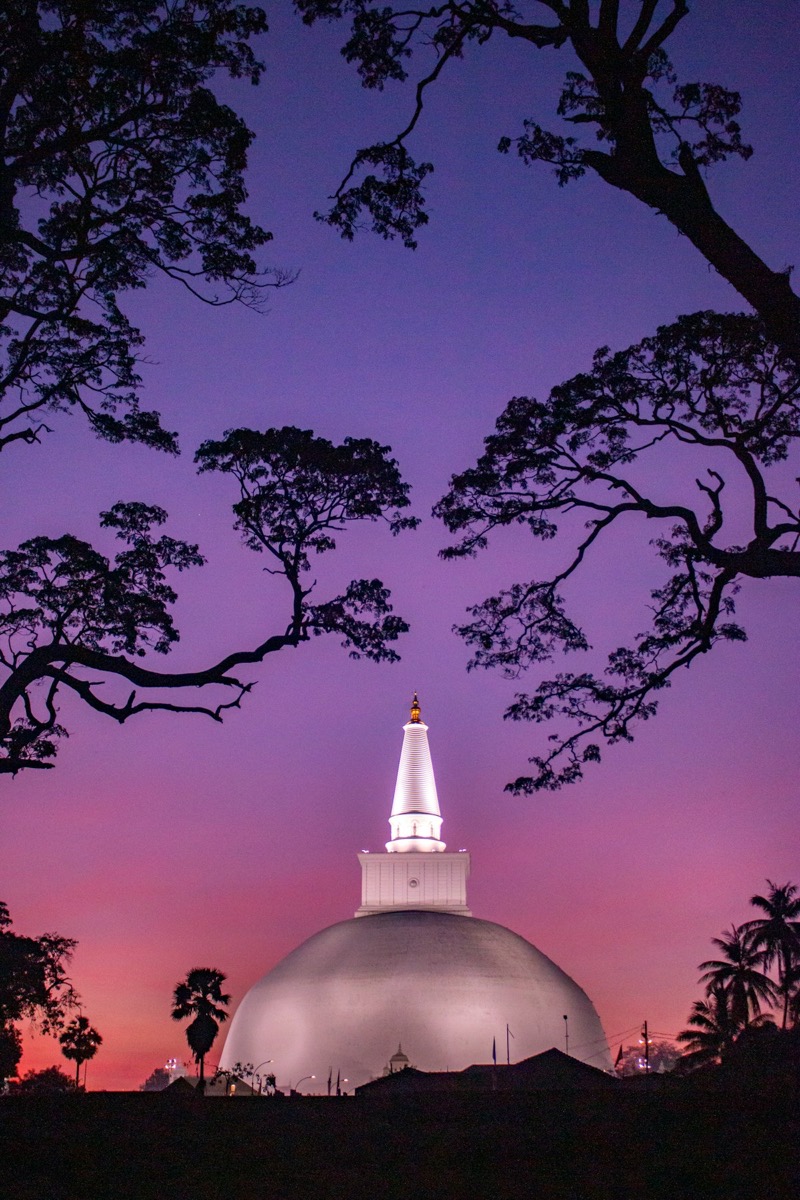
Ruwanwelisaya Stupa
What it is: The largest active stupa in Anuradhapura and one of the most important in Sri Lanka. Built by King Dutugamunu in the 2nd century BCE (constructed 137 BCE, not completed in his lifetime). The stupa was built to enshrine relics of the Buddha. Its current restored height is 103 metres; the base diameter is 91 metres.
What to expect: A massive white plastered dome dominating the precinct. The processional path around the base is bordered by a wall of elephant statues (the “elephant wall” - a continuous frieze of stone elephant heads). Pilgrims circumambulate clockwise, making offerings at the four directional shrines around the base. The stupa is surrounded by a large paved precinct open to the sky.
Early morning: The stupa glows white against a clear sky and the light is flattering. By midday the white surface reflects intense heat.
Evening: Some visitors return for the evening puja when oil lamps and flower offerings accumulate at the base shrines.
Time: 30–45 minutes including the circumambulation.
Jetavanaramaya
What it is: One of the largest brick structures ever built by humans. At its full height of approximately 122 metres, it was briefly (3rd century CE) the third tallest structure in the ancient world after the Egyptian pyramids. Built by King Mahasena. Estimated 93 million hand-made fired bricks.
What it looks like today: The upper section has partially collapsed and the height is now about 70 metres. The surface shows as exposed red-brown brick rather than the plastered white of Ruwanwelisaya - a visual reminder that this is the unrestored version. The base diameter of 113 metres gives a sense of the original scale.
The museum: The Jetavanaramaya Archaeological Museum at the base is included in the site ticket and is one of the better site museums in the Cultural Triangle. Exhibits include gold and jewelled ornaments found in the relic chamber, bronze Buddha images, inscribed tablets, and a detailed architectural model of how the stupa originally appeared. Allow 30–45 minutes.
Crowds: Less visited than Ruwanwelisaya, which means a more contemplative experience.
Time: 45–60 minutes including the museum.
Thuparamaya
What it is: The oldest stupa in Sri Lanka, built by King Devanampiya Tissa in 247 BCE - the year Buddhism was formally established in Sri Lanka following the arrival of Mahinda Thero (son of Emperor Ashoka) from India.
What to expect: Much smaller than the great stupas of the later period - 19 metres high, a compact vatadage (circular) shape on a raised terrace. Ringed by stone pillars which are the remains of a columned walkway (valagamba) that once sheltered the stupa. The precinct is quiet and peaceful; far fewer visitors come here than to Ruwanwelisaya, despite Thuparamaya being older and historically more significant.
Significance: This was the first stupa built in Sri Lanka. According to the chronicles, it enshrines a collarbone relic of the Buddha. The modest scale relative to the later stupas is worth reflecting on - Anuradhapura’s greatest building campaign came centuries later.
Time: 20–30 minutes.
Isurumuniya Vihara
What it is: A rock temple carved into a granite outcrop at the south edge of Tissa Wewa reservoir. The site dates to the 3rd century BCE but the most famous sculpture - the Isurumuniya Lovers - is thought to be from the 5th–7th centuries.
The sculptures: The Isurumuniya Lovers is a carved relief of a seated man and woman, widely regarded as one of Sri Lanka’s finest ancient sculptures. The style shows strong Gupta-period Indian influence. The carving is housed in a small museum within the complex. The site also contains a carved panel of a royal elephant group (an elephant being groomed) and a seated royal figure that some scholars identify as King Dutugemunu.
The setting: The temple is set into the cool rock face beside the reservoir, with trees providing shade and the water visible nearby. It’s one of the most atmospheric spots in the archaeological zone - smaller and quieter than the main stupas, and genuinely worth making time for.
Time: 30–40 minutes.
Samadhi Buddha Statue
What it is: A 4th-century CE granite seated Buddha in the posture of deep meditation (samadhi). Discovered during British-era excavations and installed in a small garden.
Why it matters: The facial expression - calm, withdrawn, utterly absorbed - has been praised by scholars as one of the finest examples of ancient Buddhist sculpture in Asia. Jawaharlal Nehru reportedly had a photograph of it at his bedside and said he looked at it for solace during difficult periods.
What to see: A single statue in a simple garden enclosure. No elaborate temple around it. The directness is the point - there’s nothing to do but look at the carving.
Time: 10–15 minutes.
Brazen Palace Ruins (Lohapasada)
What it is: The ruins of a nine-storey royal palace and monastery complex, originally 1,600 rooms, built by King Dutugamunu in the 2nd century BCE. The wood and brick upper storeys have long since gone; what remains are 1,600 stone columns arranged in 40 rows of 40, standing about 1–2 metres high in a large flat area beside Sri Maha Bodhi.
What you see: Rows of granite columns stretching across an open area - a visual representation of the footprint of one of the most ambitious buildings of the ancient world. The scale is evident from the column grid.
Time: 10–15 minutes.
Tissa Wewa Lake
A 3rd century BCE reservoir still in active use for irrigation. Cycling the perimeter road (3–4km) is pleasant in the early morning. The lake edge has a range of water birds - cormorants, herons, kingfishers, egrets. Isurumuniya Vihara is on the southern shore.
A Suggested Full-Day Route
- 7am: Begin at Sri Maha Bodhi (pilgrims are active early; atmosphere is best before crowds build)
- 8am: Cycle to Ruwanwelisaya (5 minutes by bicycle)
- 9am: Brazen Palace ruins (adjacent to Sri Maha Bodhi, can be combined with early morning visit)
- 10am: Jetavanaramaya and museum (10 minutes by bicycle from Ruwanwelisaya)
- 11:30am: Thuparamaya (5 minutes from Jetavanaramaya)
- Noon: Lunch break - return to guesthouse area or a restaurant in the New Town
- 2pm: Samadhi Buddha (can be combined with Jetavanaramaya area)
- 3pm: Isurumuniya Vihara
- 4pm: Tissa Wewa perimeter ride
- 5pm: Return bicycle, done
Search hotels in Anuradhapura on Booking.com
This covers all the major monuments with time to look at each properly.
What to Bring
- Minimum 2 litres of water per person - monuments are far apart and shade is limited
- Covered clothing for the full day (no shorts or sleeveless tops)
- White clothing or a white cloth/sarong for Sri Maha Bodhi inner platforms
- Socks (to protect feet from hot stone at shoe-removal points)
- Sunscreen and a sun hat
- Cash for bicycle hire, food, and any supplementary entrance fees
Planning Your Sri Lanka Trip?
- Book tours & activities in Anuradhapura
- Find hotels in Anuradhapura
- Travel insurance for Sri Lanka
- Get a Sri Lanka eSIM
- Find flights to Sri Lanka