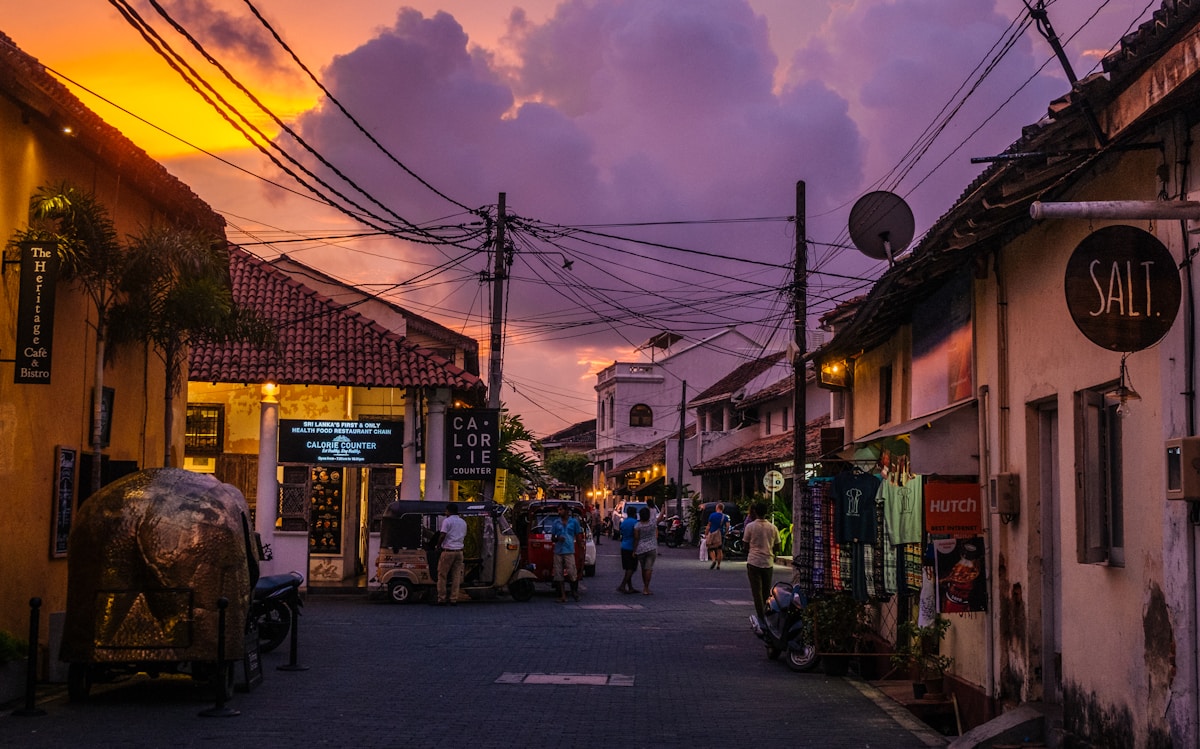
Most of what makes Galle worth visiting is concentrated in or immediately around the Fort. A half day on foot covers the main sites; a full day allows for beach time at Jungle Beach or Unawatuna and a slower pace through the streets.
Walking the Fort Ramparts
The full circuit of the Fort ramparts is 2km and takes 45 minutes to an hour at a walking pace. The path runs along the top of the outer walls and gives unobstructed views over the Indian Ocean to the south and west, and back over the Fort’s rooftops and the cricket ground to the east. No entry fee.
The best time is late afternoon - between 5pm and 6:30pm - when the light drops and the temperature eases. The section near the lighthouse and Flag Rock Bastion fills up at sunset; arrive by 5:15pm to claim a good spot on the wall. The ramparts are safe and well-maintained but unlit at night.
Clock Tower and Fort Gate
The Clock Tower (1883) stands just inside the Fort main gate on Church Street. The main gate itself is the original Dutch-era entrance and gives the best view of the Fort walls from ground level. The area around the gate is a useful orientation point - all the main streets run from here.
Old Dutch Hospital
The Old Dutch Hospital is one of the oldest buildings in Galle Fort, dating from the 17th century. It was restored in the early 2000s and now houses an open-air dining and shopping complex on the ramparts, with several separate operators rather than a single restaurant or food hall. The restoration maintained the original Dutch vaulted roofline. It is worth walking through even if you don’t eat - the courtyard gives a good sense of what the Fort’s institutional buildings looked like before conversion.
Dutch Reformed Church
Built in 1755 on Church Street, the Dutch Reformed Church (Groote Kerk) is the oldest Protestant church in Sri Lanka. The building is simple inside - whitewashed walls, dark wooden pews - with one distinctive feature: the floor is paved with original Dutch tombstones, inscribed with the names and dates of VOC officials and merchants buried beneath. The church is open to visitors during the day; there is no formal entry charge, though a donation is appropriate.
All Saints’ Anglican Church
A smaller colonial-era church on Light House Street, built by the British in 1869. Less visited than the Dutch church, with a more intimate interior and a garden cemetery behind. Worth a brief stop if you are walking past.
Galle Lighthouse
The Galle Lighthouse (1939) stands on the southwestern tip of the Fort at Point Utrecht Bastion. It is a working lighthouse and is not open to the public inside. The exterior and its position on the rocks above the sea make it a natural stopping point on any rampart walk.
National Maritime Museum
Located on Queens Street inside the Fort, the maritime museum has exhibits on the Indian Ocean trade, the Portuguese and Dutch periods in Galle, traditional Sri Lankan fishing craft, and items recovered from shipwrecks in Galle waters. Entry is around LKR 500 for foreigners. A modest but worthwhile hour if you have an interest in the Fort’s history.
Galle Fort History Museum
A smaller collection on Church Street with photographs, maps, and artefacts covering Galle’s history from before European contact. Entry is low (LKR 100–200). Less developed than the maritime museum but useful for context before walking the streets.
Jungle Beach
Jungle Beach is a small cove below Rumassala Hill, about 3km east of the Fort (10 minutes by tuk-tuk, around LKR 250–300). It is calmer and less developed than Unawatuna, with no beach bars, fewer sunbeds, and better snorkelling in the rocks at the edges of the cove. Bring your own snorkel gear if you have it - rental is sometimes available but not guaranteed.
The water is calm and clear on most days from November to April. No entry fee.
Galle International Cricket Stadium
The cricket ground is visible from the eastern ramparts of the Fort. When no match is scheduled, it is possible to view it from the ramparts for free. When a test match is being played - typically once or twice annually - the ground is one of the most atmospheric in world cricket, the Fort walls forming a backdrop to the play from the pavilion end. Check the Sri Lanka Cricket website for the schedule if you want to attend a match.
Rumassala Hill
Behind Jungle Beach, Rumassala Hill is a small forested headland with a mix of mature trees and secondary growth. Local tradition connects the hill to the Ramayana story. It is a reasonable birdwatching spot and has a Japanese Peace Pagoda at the top, built in 1978. A return walk from the beach takes about 1.5 hours.
Outside the Fort: Galle Fish Market
The Galle fish market operates near the harbour, outside the Fort walls. It is at its most active before 8am. Large quantities of tuna, seer fish, and reef fish are landed and sold here daily. Not a tourist attraction as such - a functioning wholesale market - but worth visiting early if you want to see how Galle operates beyond the boutique streets.
Practical Notes
- Give the Fort at least half a day on foot; rushing through takes less time but misses the detail. Guided walking tours of Galle Fort add historical context to what you’re seeing and typically run 2–3 hours.
- The Fort streets are narrow and cars are present - watch your step
- Most restaurants inside the Fort are open noon–10pm; the most popular fill up by 7pm
- Tuk-tuk drivers outside the Fort gate are persistent but prices are negotiable
- Closenberg Hotel (5km east on Closenberg Road) is a Victorian-era hotel with afternoon tea - worth the detour for a historical aside
Most visitors to Galle Fort stay one to three nights - it’s a destination best experienced in the early morning and evening when day-trippers have left. Search hotels in Galle inside and around the Fort.
Planning Your Sri Lanka Trip?
- Book tours & activities in Galle
- Find hotels in Galle
- Travel insurance for Sri Lanka
- Get a Sri Lanka eSIM
- Find flights to Sri Lanka