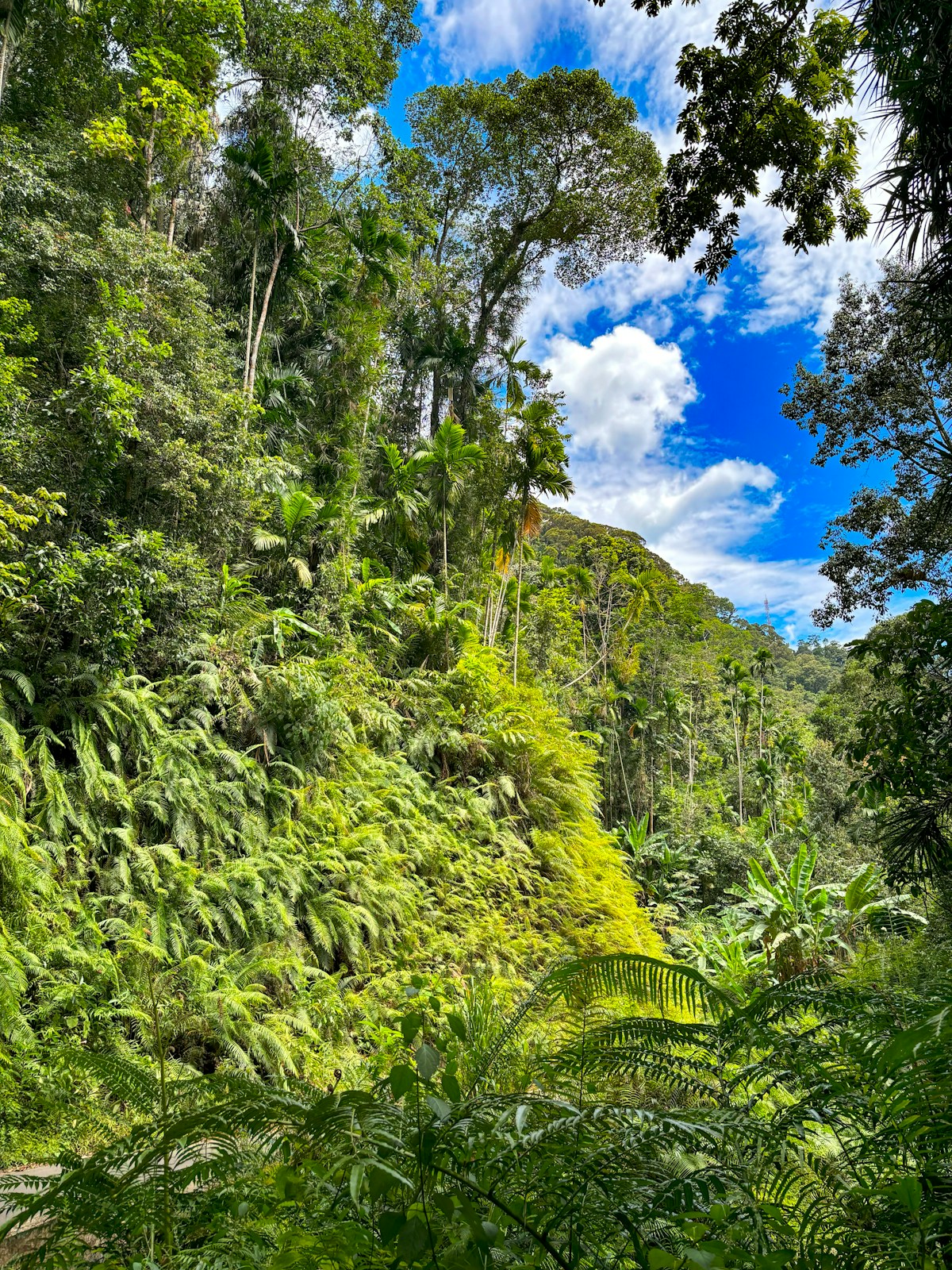
Sinharaja Forest Reserve is the largest surviving area of primary lowland tropical rainforest in Sri Lanka, covering approximately 11,187 hectares in the wet zone of the southern interior. UNESCO designated it a World Heritage Site in 1988. The name translates from Sinhalese as “Lion Kingdom.” It is not, in practice, a place where you walk unaccompanied through the undergrowth looking for leopards. It is a guided experience - forest department rules require all visitors to use a registered local guide - and one of the finest places in South Asia for birding and forest ecology.
What Makes Sinharaja Unique
The forest is a fragment of what was once continuous lowland rainforest across Sri Lanka’s wet zone. Today it is an island of primary growth surrounded by tea estates and secondary forest. Its isolation has made it a refugium for species found nowhere else on Earth. Of Sri Lanka’s endemic bird species, 95% have been recorded in Sinharaja. Of the tree species in the reserve, 60% are endemic to the island.
The ecological density is visible even to non-specialists. The forest floor is carpeted in mosses and ferns; the understory is filled with rattan, wild ginger, and endemic herbs; the canopy reaches 40 metres in places. Reptiles are everywhere - skinks and lizards dart across the path constantly, and geckos are audible at night.
Rainfall is high - Sinharaja receives around 2,500–5,000mm annually - and the air is consistently humid even during the drier months. This creates ideal conditions for the epiphytes, mosses, and orchids that cover every fallen trunk.
Getting to Sinharaja
Main Entrance: Kudawa (Weddagala)
The standard approach for most visitors is via the Kudawa entrance, near the village of Weddagala in Ratnapura District. From Colombo, the drive takes approximately 3.5 to 4 hours via the Ratnapura highway. From Ratnapura town, the journey to Kudawa is another 35km on increasingly narrow roads.
There is no direct public bus to Kudawa. From Ratnapura, take a bus towards Kalawana and change to a three-wheeler at Kalawana junction for the final stretch (approximately LKR 800–1,200). Hiring a vehicle from Ratnapura costs around LKR 3,000–4,000 return. Guided Sinharaja birding and trekking tours typically include transport from Colombo or Galle and a specialist guide, which is the most efficient way to reach the reserve.
Southern Entrance: Deniyaya
The Deniyaya entrance is used by visitors approaching from Matara or Galle on the south coast. Deniyaya is about 2 hours from Matara. Regular buses connect Matara to Deniyaya (approximately LKR 150). From Deniyaya town, three-wheelers take visitors to the forest edge.
Permits and Guides
The Department of Wildlife Conservation office at Kudawa handles all permits and guide assignments. The entrance fee for foreign visitors is approximately LKR 1,500 as of 2026 - confirm the current rate at the entrance as fees are subject to change.
Guides are assigned at the entrance and are mandatory. They are local men (predominantly from nearby villages) with deep knowledge of the forest and its wildlife. A half-day walk with a guide costs approximately LKR 2,000–4,000 depending on group size and negotiated rate. Full-day and overnight options are available for more serious birders.
Tipping guides at the end of a walk is customary and expected - LKR 500–1,000 per person for a morning walk is reasonable.
What to See: Birds
Sinharaja is primarily visited for birds, and for good reason. The mixed-species foraging flocks that move through the forest in the morning hours are one of the most impressive wildlife spectacles on the island.
Key species to look for:
- Sri Lanka blue magpie - one of the most visually striking endemic birds; vocal and relatively approachable
- Red-faced malkoha - a large, crimson-faced cuckoo that moves through the mid-canopy
- Serendib scops owl - discovered in Sinharaja in 2004, one of the most recent bird discoveries in Asia
- Sri Lanka spurfowl - often heard before it is seen; the call is a series of loud, descending notes
- Green-billed coucal - a low-canopy specialist found only in Sri Lanka’s wet zone
- Sri Lanka blue magpie, Sri Lanka jungle fowl, Malabar trogon, Sri Lanka hanging parrot
A dedicated birder arriving before dawn and joining a mixed flock for a morning session can reasonably expect 60 to 90 species on a single day.
What to See: Mammals and Reptiles
Mammals are present but harder to observe than birds. The most regularly seen species is the purple-faced leaf monkey - endemic to Sri Lanka, these grey-faced langurs are active in the canopy and relatively confiding near the forest edge. Squirrels (two endemic species) are seen on most walks.
Sri Lanka leopard, fishing cat, and rusty-spotted cat all inhabit the reserve but are rarely seen. Porcupines, civets, and giant squirrels move at night. Your guide can identify footprints and scratch marks.
Reptiles are diverse and conspicuous: the Sri Lanka chameleon changes colour in the undergrowth; the green pit viper coils on low branches (venomous - watch where you put your hands); knuckle lizards dart across the path; and the water monitor visits streams. Endemic gecko species are active from dusk.
Trekking Routes
Short nature walk (2–3 hours): The main trail from Kudawa entrance follows a well-worn path through lowland rainforest to a viewpoint and river. This is the standard option for most visitors and covers the area where mixed flocks are most reliably encountered in the morning.
Half-day walk (4–5 hours): Extends further into the reserve, passing through several vegetation zones and crossing a stream or two. Involves some uphill terrain. Best for dedicated birders.
Full-day or overnight trek: Reaches the core zone of the reserve and higher elevation forest. Advance booking through the DWC office is required. Camping facilities are basic - most serious birders arrange stays at lodges near the forest edge (see below).
Where to Stay Near Sinharaja
There is no accommodation inside the reserve. The villages nearest the Kudawa entrance have a small number of guesthouses.
Sinharaja Rest (government rest house near Kudawa): Basic rooms, from approximately LKR 3,000–5,000 per night. Book through the DWC office.
Blue Magpie Lodge (Deniyaya area): A dedicated birding lodge with comfortable accommodation and an in-house guide. Rates from approximately USD 80–120 per night including meals.
Practical Tips
Leeches: Sinharaja has large numbers of land leeches, especially after rain. Tuck trousers into socks, apply a salt solution or commercial repellent to boots and socks before entering the forest. Check ankles and shins regularly. Leeches are harmless but their bites bleed for longer than expected.
What to bring: Long trousers, closed shoes, insect repellent, water (at least 1.5 litres), snacks, a rain jacket (even in the dry season, afternoon showers are possible), and binoculars if you are birding.
Timing: Start as early as possible. The most productive birding window is 6:30am to 10:30am. The heat and humidity of midday slow activity.
Photography: The light inside the forest is low even at midday. A fast lens is essential for bird photography - f/2.8 or faster, and a telephoto of at least 300mm for canopy species.
Plan Your Trip
Sinharaja is most often visited as part of a southern Sri Lanka circuit. The nearest coastal base is the south coast, where towns like Galle and Unawatuna are 2–3 hours by road - Hotels in Galle make a convenient overnight base for an early morning drive into the reserve. From the hill country, Ella is roughly 2 hours east. If you’re combining wildlife parks, Udawalawe National Park is around 90 minutes northeast of the Deniyaya entrance - making a combined Sinharaja–Udawalawe day route feasible from a south coast base. For context on the best months to visit, see the Sri Lanka best time to visit guide.
Related Guides
- Galle travel guide - nearest city base; 2–3 hours from Sinharaja
- Udawalawe National Park safari - 90 minutes northeast; elephants guaranteed year-round
- Sri Lanka safari comparison guide - Sinharaja vs Yala vs Udawalawe for wildlife
- Tea country trekking guide - highland walking in the same region
- Sri Lanka packing list - what to bring for leech country and rainforest walking
- Best time to visit Sri Lanka - Sinharaja’s wet and dry seasons