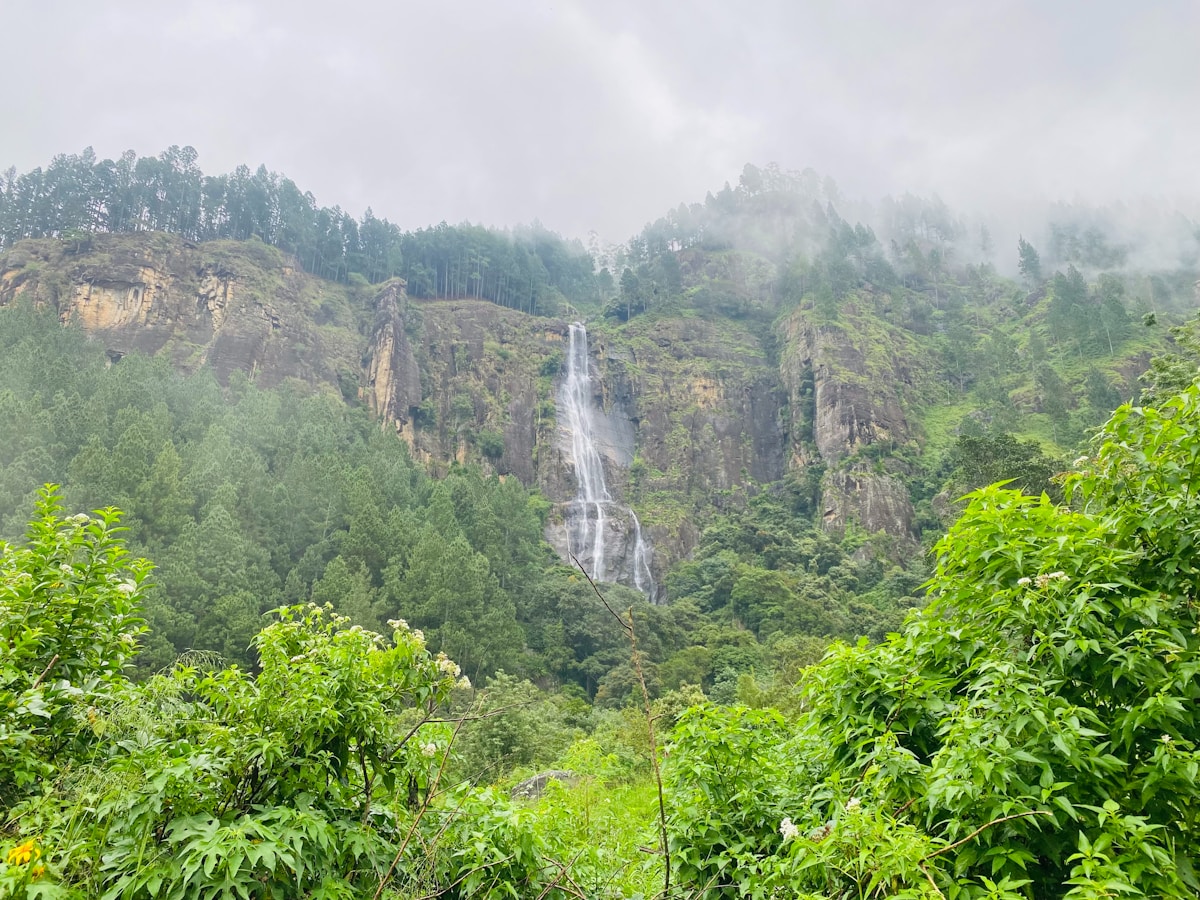
Sri Lanka packs a surprising number of waterfalls into a relatively compact landmass. The central highlands, Uva Province, and the hill country around Ella and Haputale hold the largest and most dramatic falls. Here we cover the four that consistently reward a detour, in order from tallest to most accessible.
Bambarakanda Falls - Sri Lanka’s Tallest
Bambarakanda Falls, in the Uva Province near Kalupahana between Haputale and Belihuloya, drops approximately 263 metres in a single plunge - making it the tallest waterfall in Sri Lanka and one of the tallest in South Asia. The flow is seasonal: at peak (April–June, November–January) the cascade is genuinely dramatic; in the drier months it can thin to a ribbon.
Getting there: From Haputale, take the A4 road west toward Belihuloya. At Kalupahana junction, turn onto the B394 road toward the waterfall. The falls are visible from the roadside after roughly 10km - a vehicle is essential; no public bus runs the final stretch. By tuk-tuk from Haputale: approximately LKR 2,000–3,000 return (confirm the fare before departure).
Nearest guesthouses: The small town of Haputale, 14km east, has the best choice. Olympus Plaza Hotel offers rooms from approximately LKR 5,000–8,000 per night (as of 2026) and can arrange transport. Slightly closer, the Belihuloya Rest House sits by the Walawe River and offers rooms from around LKR 4,000.
Entry fee: No formal entry fee. The viewpoint is roadside.
Best season: April–June is peak flow. The surrounding countryside is also at its greenest.
Diyaluma Falls - Highest Single-Drop for Swimmers
Diyaluma Falls near Koslanda, between Wellawaya and Haputale, drops 171 metres in a single-tier plunge - the second highest in Sri Lanka. Unlike Bambarakanda, Diyaluma has accessible natural pools at the top of the falls reached by a 45-minute hike from the base. Swimming in these upper pools overlooking the valley is the draw.
Getting there: Diyaluma is on the A4 highway between Wellawaya and Koslanda, clearly signposted. Buses running between Badulla and Embilipitiya stop at Koslanda (frequent service from Wellawaya). Tuk-tuk from Wellawaya is approximately LKR 1,500–2,000.
The hike to the top pools: Follow the path from the base viewpoint area (right side of the falls) uphill through private land. Locals sometimes ask for a passage fee of LKR 100–200. The upper pools are cool, clear, and deep enough for swimming. The walk takes 30–45 minutes and involves uneven terrain. Wear proper footwear.
Entry fee: A conservation fee of approximately LKR 200–300 per person is charged at the base (as of 2026).
Nearest guesthouses: The village of Wellawaya, 12km south on the A4, has a cluster of small guesthouses. Lanka Rainbow Inn offers rooms from around LKR 3,500–5,500 per night. Ella (25km east) has far more choice, including Mid-Budget options such as Ella Jungle Resort (from approximately LKR 8,000) and budget guesthouses from LKR 2,000.
Best season: November to January and April to June for fullest volume.
Ravana Falls - Most Accessible from Ella
Ravana Falls is the easiest waterfall to visit in Sri Lanka - it sits directly on the A23 highway between Ella and Wellawaya, just 6km from Ella town. The falls drop around 25 metres in a broad tiered curtain directly visible from the roadside. Buses stop practically in front of it; tuk-tuks from Ella cost approximately LKR 300–500 each way.
What to expect: Because of its roadside accessibility, Ravana is the most visited waterfall in the country during peak season. It can be genuinely crowded between December and March. The base pool is shallow and sometimes murky. Go early morning (before 8am) for photographs before the tour groups arrive.
Getting there: Any bus or tuk-tuk on the Ella–Wellawaya route passes Ravana Falls. Tuk-tuk from Ella town: approximately LKR 400–600 return.
Entry fee: No formal fee. Unofficial guides and hawkers are present and will solicit contributions.
Nearest guesthouses: Ella is the natural base. Options range from budget guesthouses (LKR 2,000–4,000 per night) to mid-range Ella Jungle Resort and upmarket 98 Acres Resort & Spa (from approximately USD 80 per night as of 2026). Most Ella guesthouses can arrange tuk-tuk transport to the falls.
Best season: Year-round, but flow is strongest November–January and April–June. The falls can be a trickle in February–March.
Dunhinda Falls - Most Dramatic Setting
Dunhinda Falls, 6km north of Badulla, is one of Sri Lanka’s most powerful waterfalls by volume - a 64-metre drop that generates a permanent mist over the surrounding jungle. The name “Dunhinda” translates as “smoky water,” a reference to the spray cloud visible from distance. The setting - dense jungle, suspension bridge, and mist - makes this the most dramatic atmosphere of any waterfall on the island.
Getting there: From Badulla town, tuk-tuks to the Dunhinda Falls trailhead cost approximately LKR 800–1,200 (as of 2026). There is also an infrequent local bus from Badulla. A well-maintained walking trail of 1.5km leads from the car park to the main viewpoint, taking around 20–30 minutes.
Entry fee: A conservation fee of approximately LKR 200–350 per person applies for foreigners (as of 2026). Confirm at the gate as fees are periodically updated.
Nearest guesthouses: Badulla town, 6km south, has functional guesthouses and a few hotels. Hotel Dunhinda Falls Inn, adjacent to the trailhead area, offers rooms from approximately LKR 4,000–6,000 per night. Badulla’s train station connects to the Kandy–Ella mainline, making it accessible from the hill country route.
Best season: April–June and November–January. The falls are genuinely powerful year-round due to the catchment area, but peak monsoon flow is dramatically louder.
Planning a Waterfall Route
The four waterfalls can be combined into a sensible two to three day loop from Ella. Guided waterfall and hill country tours from Ella are a useful option if you don’t want to coordinate local transport between multiple stops.
- Day 1: Ella base - morning hike to Ravana Falls (early to avoid crowds), afternoon drive to Diyaluma with upper pool swim
- Day 2: Drive to Haputale via the A4; detour to Bambarakanda if flow season; base in Haputale for the Lipton’s Seat and tea country
- Day 3 (optional): Bus or train from Haputale toward Badulla; stop at Dunhinda Falls before continuing to Kandy or Colombo
This route works in either direction. The Ella–Haputale stretch by road takes around 1.5 hours; Haputale to Badulla is a further 40 minutes.
Practical Notes
- Transport: A rented tuk-tuk or hired car for a full day (approximately LKR 5,000–8,000 as of 2026) is the most efficient way to cover multiple waterfalls in a single loop. Train tickets from Ella to Badulla or Haputale can be booked at Ella station or through ExpoRail (exporail.lk)
- Footwear: Proper walking shoes or trail sandals - the paths to Diyaluma and Dunhinda are uneven and can be slippery
- Timing: Early morning visits to Ravana Falls avoid the crowds and provide better photography light
- Leech season: During heavy monsoon, leeches are present on jungle paths near Dunhinda and Diyaluma. Leech socks or long trousers tucked into socks are the practical fix
- Water: Carry your own water - vendors near the falls can be expensive and unreliable
Plan Your Trip
Related Guides
- Tea country trekking guide - walking routes connecting the waterfalls and tea estates
- Kandy to Ella train guide - the scenic route through waterfall country
- Horton Plains National Park - Baker’s Falls is a highlight of the Horton Plains circuit
- Sri Lanka photography guide - waterfall photography tips and timing advice
- Best time to visit Sri Lanka - post-monsoon months give maximum waterfall flow