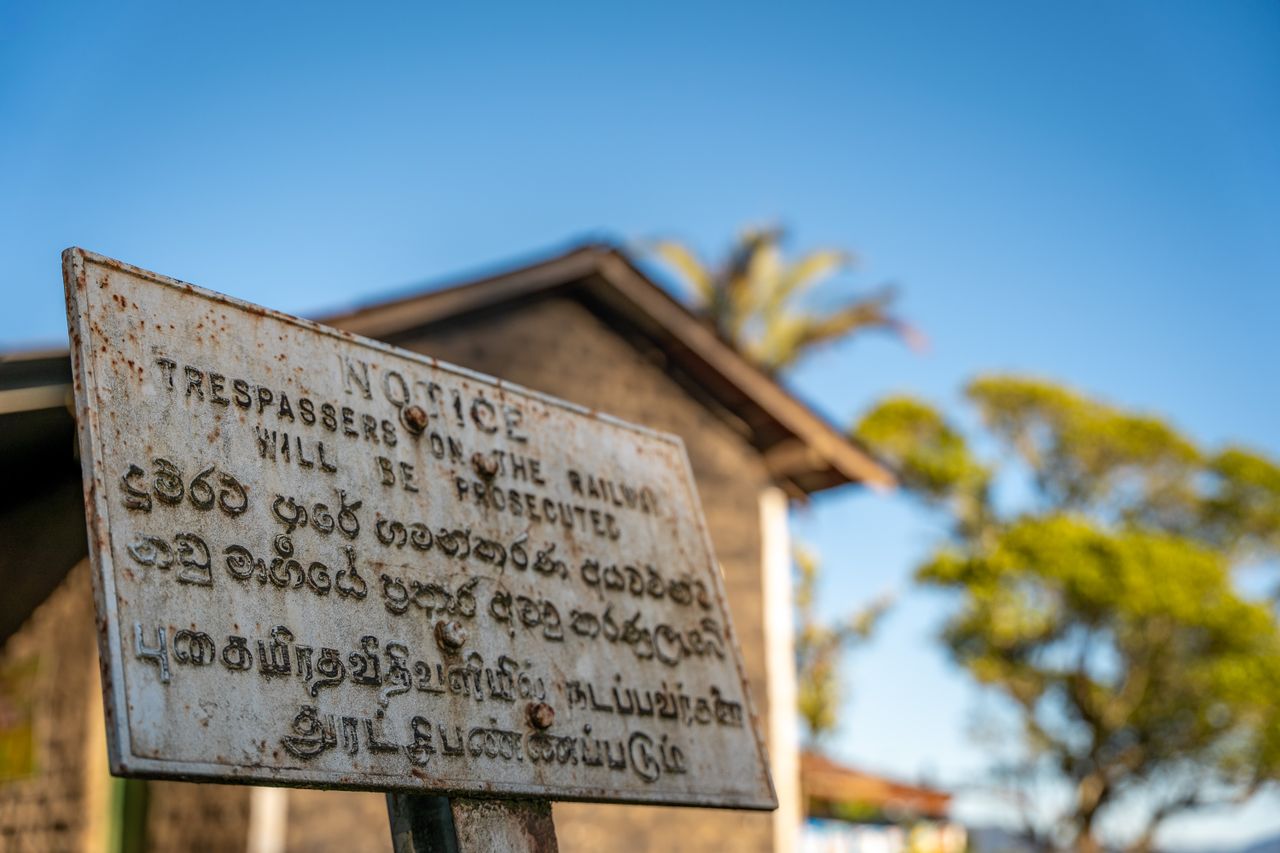
Sri Lanka has two official languages - Sinhala and Tamil - and English running throughout as a practical third. Most travellers get through the trip entirely on English, but making the effort to use a few local words transforms interactions. A correct ayubowan at a guesthouse reception, or asking for the bill in Sinhala at a local restaurant, tends to get a genuinely warm reaction.
The Languages of Sri Lanka
Sinhala (Siṃhala in the script) is an Indo-Aryan language related to Sanskrit and Pali, spoken by roughly 16 million people - primarily the Sinhalese ethnic majority in the south, west, and central regions. It is written in the Sinhala script, a distinctive rounded alphabet with 52 letters that descends from the Brahmi script. The script is beautiful to look at but bears no resemblance to the Latin alphabet, so most travellers rely on romanised transliteration.
Tamil (தமிழ்) is a Dravidian language with its own ancient literary tradition, spoken by around 3.5 million Sri Lankans - the Sri Lankan Tamil community in the north and east, and the Hill Country Tamil community in the tea-growing highlands. Tamil has its own script. If you’re spending significant time in Jaffna, Trincomalee, or Nuwara Eliya, a few Tamil phrases are appreciated.
English is Sri Lanka’s link language - a legacy of British colonial rule from 1815 to 1948. It’s taught in schools and spoken fluently by most people working in hospitality, transport, and commerce. Outside tourist areas in rural villages, English knowledge drops significantly, which is where the phrases below come in.
Sinhala Pronunciation Guide
Sinhala pronunciation is broadly consistent - once you know a handful of rules, words read as spelled.
| Sound | How to pronounce | Example |
|---|---|---|
| a | short “ah” as in “father” | api (we) |
| aa | long “aah” | aama (yes) |
| e | like “eh” in “bed” | ekai (one) |
| i | short “ih” | inna (stay) |
| ii | long “ee” | kiima (eating) |
| u | short “oo” | uda (up) |
| uu | long “oo” | uuu - rare |
| g | always hard, as in “go” | gama (village) |
| th | not like English “th” - say a soft “t” | thé (tea) |
| dh | a soft “d” with the tongue near the teeth | dhanna (rice) |
| l | normal “l” | loku (big) |
| h | breathy, as in “him” | hamadama (always) |
Stress in Sinhala generally falls on the first syllable. AY-oo-boh-wan, not ay-oo-BOH-wan (though most locals will understand either way).
Tonal awareness: Sinhala is not a tonal language. Unlike Mandarin or Thai, the pitch of your voice does not change word meaning. Speak clearly and at a measured pace - Sri Lankans are patient listeners.
Essential Sinhala Phrases
Greetings and Basics
| English | Sinhala (romanised) | Pronunciation guide |
|---|---|---|
| Hello / Goodbye | Ayubowan | ah-yoo-BOH-wan |
| How are you? | Kohomada? | koh-HOH-ma-da |
| I’m fine, thanks | Hondain, istuti | HON-dain, is-TOO-ti |
| Thank you | Istuti | is-TOO-ti |
| Thank you very much | Bohoma istuti | BOH-hoh-ma is-TOO-ti |
| Please | Karunaakara | ka-roo-NAA-ka-ra |
| Yes | Ow / Aama | ow / AA-ma |
| No | Naa / Nehe | naa / NEH-heh |
| Sorry / Excuse me | Samaavenna | sa-MAA-ven-na |
| I don’t understand | Mata thereen neh | ma-TA theh-REEN neh |
| Do you speak English? | Oyaa ingrisi kathaa karanavaadha? | oh-YAA in-gri-SI ka-THAA ka-ra-na-VAA-da |
| My name is… | Mage naama… | ma-GEH NAA-ma |
Getting Around
| English | Sinhala (romanised) | Pronunciation guide |
|---|---|---|
| Where is…? | …koheda? | …koh-HEH-da |
| How far? | Kohomadha dhurak? | koh-HOH-ma-da DOO-rak |
| Left | Wam passen | wam PAS-sen |
| Right | Daku passen | da-KOO PAS-sen |
| Straight ahead | Kelina yanna | keh-LI-na YAN-na |
| Stop here | Mehe nawatanna | MEH-heh na-wa-TAN-na |
| Train station | Dumriya pola | doom-RI-ya POH-la |
| Bus station | Bas niwaathuma | bas ni-WAA-too-ma |
| Airport | Guwanathala | goo-wan-a-TAA-la |
| How much is the fare? | Eke gana kiyada? | EH-keh GA-na KI-ya-da |
| Please take me to… | Maava… yanava | MAA-va… ya-NA-va |
| Too fast | Wadi bedagena | wa-DI beh-da-GEH-na |
Accommodation
| English | Sinhala (romanised) | Pronunciation guide |
|---|---|---|
| Hotel / Guesthouse | Hoothalaya / Wissraam Haley | hoh-tha-LA-ya |
| Do you have a room? | Kamara thibenaavadha? | ka-MA-ra thi-BEH-naa-va-da |
| How much per night? | Raakaya kiyada? | RAA-ka-ya KI-ya-da |
| One night | Raathriyak | RAAT-ri-yak |
| Two nights | Raathri dekak | RAAT-ri DEH-kak |
| Hot water | Unu wathura | OO-noo wa-TOO-ra |
| Air conditioning | Air conditioning | (borrowed word - same) |
| What time is check-out? | Chekkout welawa kiyada? | (borrowed: chek-OWT) |
| Can I see the room first? | Kamaraya balanna puluwandha? | ka-MA-ra-ya ba-LAN-na POO-loo-wan-da |
Food and Drink
| English | Sinhala (romanised) | Pronunciation guide |
|---|---|---|
| Menu / What do you have? | Menoo eka / Monavaadha thibenney? | MEH-noo EH-ka |
| I’d like… | Mata… oona | ma-TA… OO-na |
| Rice and curry | Bath saha kari | bath SA-ha KA-ri |
| Roti | Roti | ROH-ti |
| Fish | Maalu | MAA-loo |
| Chicken | Kukul maas | koo-KOOL maas |
| Vegetarian | Saakaaree | saa-KAA-ree |
| Without chilli | Miris nathuwa | MI-ris na-TOO-wa |
| Water | Wathura | wa-TOO-ra |
| Tea | Thé | teh |
| Coffee | Koopi | KOH-pi |
| Coconut water | Kurumba | koo-ROOM-ba |
| The bill, please | Ganan kaagada, karunaakara | GA-nan KAA-ga-da |
| Delicious! | Rasai! | RA-sai |
| A little spicy | Podi karamak | POH-di ka-RA-mak |
| Very spicy | Harak karam | ha-RAK ka-RAM |
Shopping
| English | Sinhala (romanised) | Pronunciation guide |
|---|---|---|
| How much does this cost? | Meka kiyada? | MEH-ka KI-ya-da |
| Too expensive | Harak gunak | ha-RAK goo-NAK |
| Can you lower the price? | Gana wadi karanna puluwandha? | GA-na wa-DI… |
| I’ll take it | Mama meka gannaava | MA-ma MEH-ka GAN-naa-va |
| I’m just looking | Mama balala yannaava | MA-ma ba-LA-la YAN-naa-va |
Emergencies
| English | Sinhala (romanised) | Pronunciation guide |
|---|---|---|
| Help! | Udaw karanna! | OO-daw ka-RAN-na |
| Doctor | Dhokthar | DOK-tar |
| Hospital | Hospithalaya | hos-pi-TAA-la-ya |
| Police | Poliisiya | poh-LEE-si-ya |
| I’m sick | Mata ledak thiyanava | ma-TA LEH-dak thi-YA-na-va |
| I need medicine | Mata behetha oona | ma-TA beh-HEH-ta OO-na |
| Call an ambulance | Ambulansakaraya genanna | am-boo-LAN-sa… |
| Fire! | Agini! | a-GI-ni |
| Theft / I’ve been robbed | Hora gandiya / Mava horu | HOH-ra GAN-di-ya |
Numbers
| Number | Sinhala | Pronunciation |
|---|---|---|
| 1 | Ekai | EH-kai |
| 2 | Dekai | DEH-kai |
| 3 | Thunak | THOO-nak |
| 4 | Hatharai | ha-THA-rai |
| 5 | Pahak | PA-hak |
| 6 | Hayak | HA-yak |
| 7 | Hathak | ha-THAK |
| 8 | Atak | A-tak |
| 9 | Navayak | na-VA-yak |
| 10 | Dahai | da-HAI |
| 20 | Vissai | vi-SAI |
| 50 | Panchaasai | pan-CHAA-sai |
| 100 | Siyayak | si-YA-yak |
| 1,000 | Dahasak | da-HA-sak |
Essential Tamil Phrases (North and East)
If you’re travelling to Jaffna, Trincomalee, or Batticaloa, switching to Tamil shows genuine cultural awareness. Tamil speakers in the north have a distinct identity and history; making the effort is genuinely appreciated.
| English | Tamil (romanised) | Pronunciation |
|---|---|---|
| Hello / Greetings | Vanakkam | va-NAK-kam |
| Thank you | Nandri | NAN-dri |
| Yes | Aamaa | AA-maa |
| No | Illai | IL-lai |
| How much? | Evvalavu? | ev-VA-la-vu |
| Where is…? | …engey irukku? | …EN-geh i-ROOK-koo |
| Water | Thanni | THAN-ni |
| Rice | Saadham | SAA-dam |
| Help! | Udavi! | oo-DA-vi |
| Stop | Nillu | NIL-loo |
| Delicious | Ruchiyaaga irukku | roo-CHI-yaa-ga |
Language Etiquette in Sri Lanka
The ayubowan gesture: When saying ayubowan, bring your palms together at chest height in a namaste-like gesture and incline your head slightly. This is the traditional form - in modern everyday life, many Sri Lankans use it selectively (with elders, monks, formal occasions) and do a regular wave or handshake with peers. Following the local lead is fine.
Addressing monks: Never address a monk informally. If you need to speak with a Buddhist monk, approach respectfully, wait until they acknowledge you, and keep the interaction brief unless they engage further. Women should not touch monks or hand items directly - place items nearby instead.
English and code-switching: Many educated Sri Lankans effortlessly switch between Sinhala, Tamil, and English mid-conversation. Don’t be surprised if someone answers your Sinhala phrase in English - it’s not dismissiveness, it’s helpfulness. Persist if you want to practise.
“No problem” culture: Sri Lankans are generally indirect when saying no. “I’ll try” or “maybe tomorrow” can mean no. If you ask for something and receive an enthusiastic response that never materialises, reading between the lines matters.
Using titles: Elders are addressed as aiya (older brother) or akka (older sister) in Sinhala, and anna / akka in Tamil. Using these with slightly older strangers (shopkeepers, drivers) lands warmly and signals cultural awareness.
Volume and patience: Speaking louder does not help comprehension. If someone doesn’t understand you, try simpler words and slower speech. Most Sri Lankans involved in tourism have exposure to many accents - patience on both sides resolves most communication gaps quickly.
Written Sinhala in tourism: Menus, buses, and street signs are often in Sinhala script only outside Colombo and major tourist hubs. Download the Google Translate app with offline Sinhala support before you travel - the camera translation feature works well on printed menus and signs.
Is English Widely Spoken?
In Colombo, Kandy, Galle, Sigiriya, Ella, and all main beach resorts: yes, very widely. Hotel staff, restaurant workers, tuk-tuk drivers in tourist areas, and tour guides all typically speak functional to fluent English.
In smaller villages, remote hill country towns, and rural markets: significantly less so. A guesthouse owner in a small tea-country village may have very limited English. Having the name of your destination written in Sinhala on your phone (copy it from Google Maps or a translation app) is a reliable backup for showing tuk-tuk drivers and local bus conductors where you’re going.
On local intercity buses, conductors may call out town names only in Sinhala. Knowing the Sinhala pronunciation of your stop name - or having it written and shown on your phone - prevents missing your destination. Major bus hubs like Colombo Fort, Kandy, and Matara operate with enough English for basic navigation.
Tamil-speaking areas in the north had limited tourism infrastructure until recently and English proficiency can be lower in rural areas around Jaffna than in the Colombo hotel belt. Younger Sri Lankans across both language groups typically have better English than older generations.
Phrases and phonetics in this guide use simplified romanisation intended for practical spoken use, not academic transliteration. Sinhala and Tamil are rich languages - the goal here is confident first attempts, not linguistics.