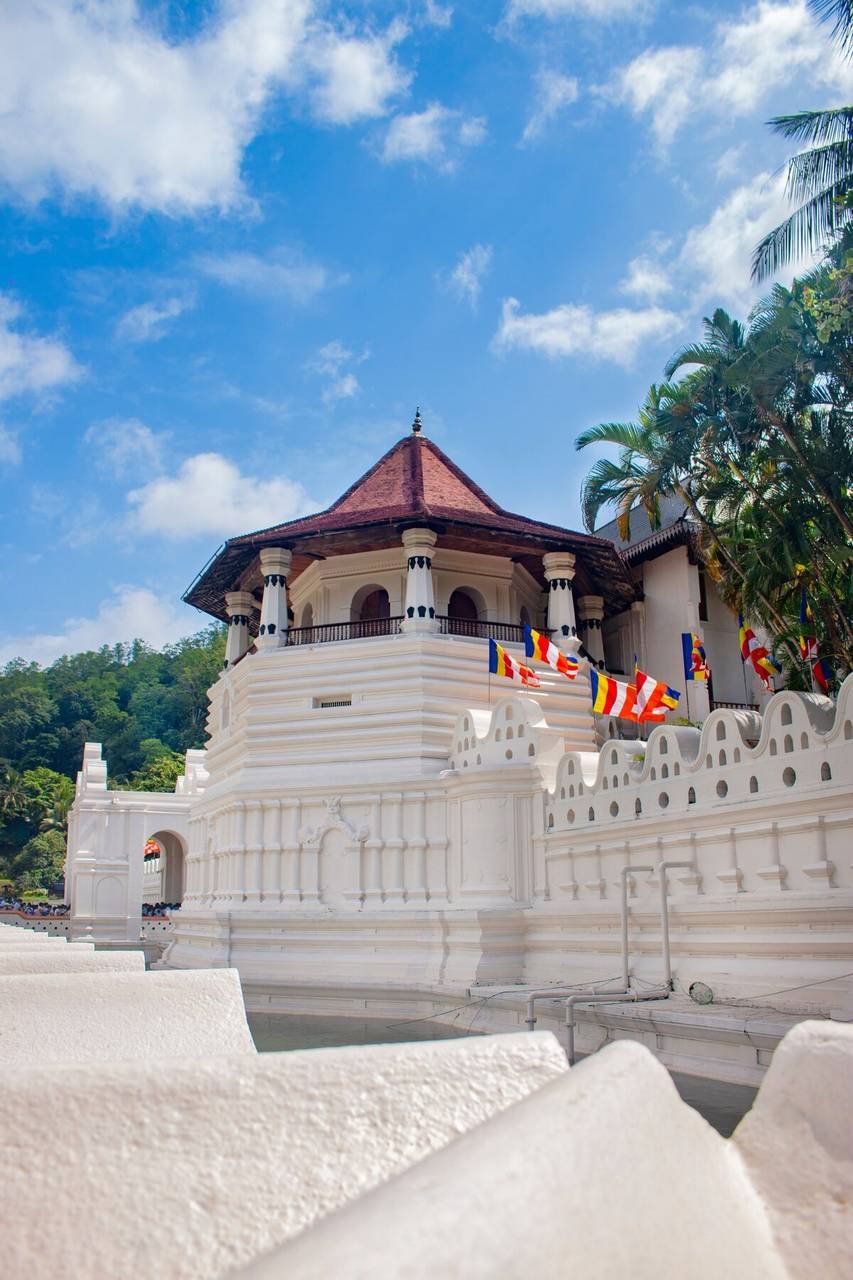
The Temple of the Tooth in Kandy, known in Sinhala as the Sri Dalada Maligawa, houses the tooth relic traditionally believed to be a canine tooth of the Buddha. It is the most important Buddhist shrine in Sri Lanka and a focal point of the Sacred City of Kandy, which UNESCO inscribed as a World Heritage Site in 1988. It is also a working temple, so a visit is as much about watching devotion unfold as it is about the architecture.
For where it sits in the wider city, see our Kandy travel guide and the things to do in Kandy page. This guide covers the practical detail for the temple alone.
Puja Times: When to Go
Three daily services (puja) are held, and the inner chamber that holds the casket is opened to visitors during each one. The official Sri Dalada Maligawa site lists these periods:
| Service | Time |
|---|---|
| Early morning | 5:30am to 7:00am |
| Middle morning | 9:30am to 11:00am |
| Evening | 6:30pm to 8:00pm |
The temple is open daily from 5:30am to 8:00pm. Each service is accompanied by drummers and horn players in the Magul Maduwa (drummers’ hall) at the entrance to the shrine, and worshippers carry lotus and frangipani offerings up the stairs to the chamber. Expect a queue at the door while the chamber is open.
Which to choose: the evening service is generally the busiest and the most atmospheric, with the most pilgrims in white. The early morning service is cooler and quieter, though it means a dawn start. The middle morning slot suits most day-trippers, but tour groups tend to cluster there. Arrive 20 to 30 minutes before the drumming begins if you want to be near the door of the chamber.
Wednesday ceremony: every Wednesday at 9:30am the temple holds Nanumura Mangallaya, the ritual bathing of the relic with a herbal preparation. Pilgrim numbers rise on Wednesdays, and also on Poya (full moon) days, when many Sri Lankans visit in white clothes. If you prefer a calmer visit, avoid Poya days.
Tickets and Entry Price
As of 2026, the official foreigner fees were revised from 1 July 2026 to:
- LKR 3,000 (about USD 10) for all nationalities other than those below
- LKR 2,500 (about USD 8) for SAARC countries, Thailand and Myanmar
Many blogs still show LKR 2,000, which was the previous rate. Tickets are issued only by machines on site, and the temple states that tickets or fees issued by other individuals or institutions are not valid. If someone outside offers a “VIP” pass or a guided entry at a premium, decline. You can book a guide separately.
Everything is screened at the entrance with scanners. Shoes, bulky bags and non-essential items go to the reception booths, where you get a token (separate booths for locals and foreigners). Plastic and polythene items, including offering bags, are not allowed, and pets are prohibited.
Dress Code
Sri Lankans take this seriously, and the temple’s own rule is that visitors in shorts, sleeveless tops or body-revealing clothing are not admitted. Plan on:
- Shoulders and knees covered (light long trousers, a long skirt or a sarong; a T-shirt or shirt with sleeves)
- Shoes and socks removed at the reception booths
- White or light colours if you want to blend in with the pilgrims, though this is not required
The stone paving outside can be very hot at midday, so the middle morning slot is the hardest on bare feet. For a longer explanation of etiquette at Buddhist sites, read our temple etiquette guide and the broader Sri Lanka etiquette and customs page. Never pose with your back to a Buddha image for a photo, and keep photography away from the puja queue.
What You Will See Inside
The complex sits beside Kandy Lake, protected by a moat and a low wall with a distinctive cloud-pattern parapet. Most of the main buildings date from the Kandyan period, including the octagonal Paththirippuwa tower that you see on the lakeside, associated with the Kandyan kings. The shrine itself is a two-storey building with a gilded roof.
- Magul Maduwa: the entrance hall with drummers and carved pillars.
- Inner shrine, upper floor: the casket room, where the golden stupa-shaped caskets sit on an altar. The relic itself is never on display. What you see is the outermost casket, shown through an open door for a few seconds as the queue moves past.
- Lower floor: a smaller shrine room with murals and a series of Buddha images.
- Octagon and library: the octagon is now used as a library of Buddhist manuscripts.
The relic has a long history. Sri Lankan tradition holds that it was brought to the island in the 4th century CE from Kalinga in India, and it moved with the capital over the centuries before settling in Kandy. Possession of the tooth was linked to the right to rule, which is why the Kandyan kings built the temple beside their palace. The complex was bombed in 1998 and has since been restored.
The Museums
The foreigner ticket covers, according to the official site, the temple plus several museums on the grounds: the Dalada Museum, the World Buddhist Museum, the Tusker Museum and the Royal Elephant Stable. Allow an extra 45 to 60 minutes for these.
- World Buddhist Museum: compares Buddhist art and traditions from Thailand, Myanmar, Japan, China, Tibet and other countries. It is the most interesting for first-time visitors.
- Dalada Museum: focuses on the history of the relic and related ritual objects.
- Tusker Museum and Royal Elephant Stable: connected to the elephant that carries the casket in the Perahera, a tie-in that makes more sense once you have seen the procession or read about it.
The museums are usually quieter than the shrine, and are a sensible plan for the hottest part of the day.
Esala Perahera: The Festival Tie-In
Each July or August the relic casket is replicated on the back of a decorated tusker in the Esala Perahera, the ten-night procession that starts and ends at the temple. The 2026 festival ran from 18 to 28 August, with the final Randoli procession on 27 August and a daytime closing procession on 28 August.
The temple is crowded on procession nights and access can be restricted, so check on the day. Our Kandy Esala Perahera guide covers viewing spots, grandstand tickets and which nights to choose. If you will be in town for the festival, book accommodation well ahead and plan the daytime temple visit for the morning, before the crowds build.
Getting There and Combining the Visit
The temple is in the centre of Kandy on Sri Dalada Veediya, right beside Kandy Lake and an easy walk from the central market and clock tower area. A tuk-tuk from the railway station is about LKR 300 to 500, and the walk is feasible if you are carrying only a day bag. Our Kandy getting around guide has fares and routes.
A sensible half-day plan: the early morning puja at 5:30am, breakfast on Dalada Veediya, a walk round the lake, then the museums. Or the late afternoon: lake walk, then the 6:30pm service. If you want a local guide who can explain the ritual, guided tours in Kandy often bundle the temple with a cultural show, the Peradeniya botanical garden or a spice garden. For a comfortable base in walking distance, see where to stay in Kandy or search Kandy hotels on Booking.com.
Kandy also has evening Kandyan dance shows, which many visitors combine with the 6:30pm puja; keep the dress code in mind and do not wear shoes inside the shrine. After Kandy, most travellers continue to the hill country by train, and our Kandy to Ella train guide is a good starting point.