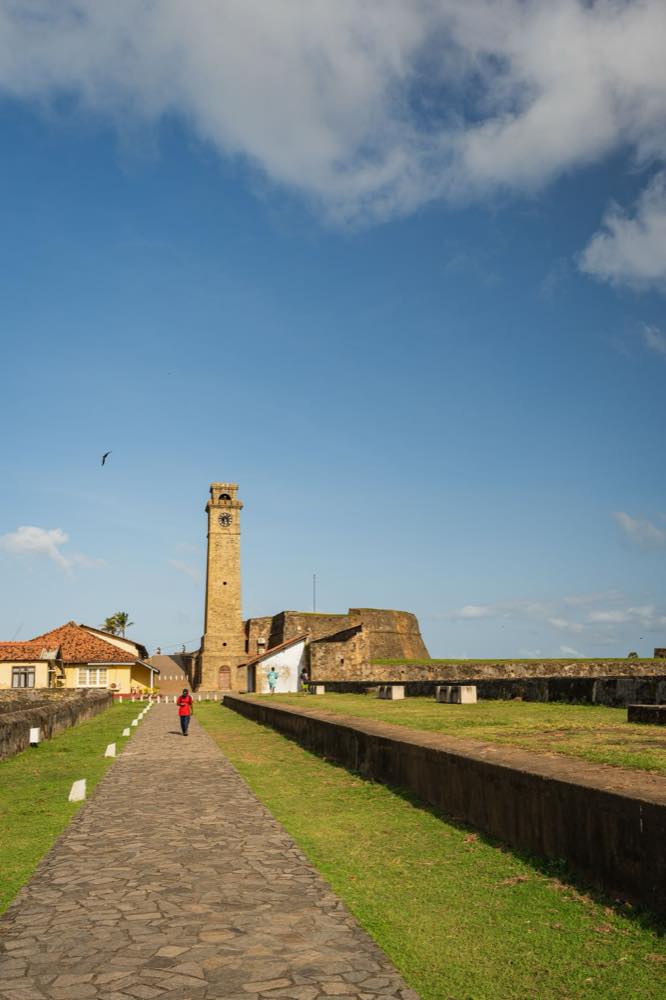
Galle Fort is a 17th-century Dutch fortification on a rocky headland on Sri Lanka’s south-west coast, and walking it is the single best half-day you can spend in Galle. The Portuguese built the first fort here in 1588, the Dutch rebuilt and extended it from 1649 into the stone ramparts you see today, and the British added the clock tower and several churches. The result is a compact, car-free grid of about 50 hectares that is still lived in, with homes, schools, mosques and temples sitting beside cafes and boutique hotels. UNESCO inscribed it as the Old Town of Galle and its Fortifications in 1988.
This page is the walking route. For the wider town (Jungle Beach, the fish market, the cricket ground) see things to do in Galle, and for the area overview see our Galle guide.
Galle Fort at a glance
| Entry | Free (ramparts and streets) |
| Rampart loop | About 2 km, 45-60 minutes non-stop |
| Full visit | 2-3 hours with stops |
| Best times | 6:30-8:30am or 4-6:30pm |
| Shade | Almost none on the walls, bring a hat and water |
| Access | Main gate by the cricket ground and bus stand; tuk-tuks drop at the gate |
Prices in this guide are approximate and as of 2026.
Where to start: the main gate and clock tower
Enter through the main gate on the north-east side, beside the cricket ground. The Dutch-era gateway carries the VOC monogram and the year 1669 on its inner face. Just inside, the Clock Tower (1883) stands on the Church Street side near the Meeran Mosque, a good orientation point because every main lane runs from here. From the gate, climb the steps onto the wall and turn clockwise, which puts the sea on your left as you walk toward the lighthouse.
The rampart circuit, bastion by bastion
The Dutch laid out a ring of bastions linked by the curtain wall, each with its own name and cannon positions. You do not need to memorise them, but a few are worth knowing as landmarks:
- Star Bastion on the eastern side, close to the gate, with good views over the cricket ground and harbour.
- Moon and Sun Bastions along the southern wall, where the walkway is widest and the ocean wind is strongest.
- Point Utrecht Bastion at the south-western tip, where the lighthouse stands.
- Flag Rock Bastion just beyond the lighthouse, the high point of the circuit and the sunset crowd’s favourite.
Walk at a steady pace, stopping where the wall widens. Sections of the wall are uneven and there are no handrails on the seaward side, so watch children and keep clear of the edge in wet weather. In some places the path steps down from the wall into a lane, and you simply rejoin it a little farther on.
Galle lighthouse and Flag Rock at sunset
The lighthouse (current tower dating from 1939) is the Fort’s postcard image, a white tower rising from the lawns of Point Utrecht Bastion. It is a working light and is closed inside, so enjoy it from the grass and the cannon beside it.
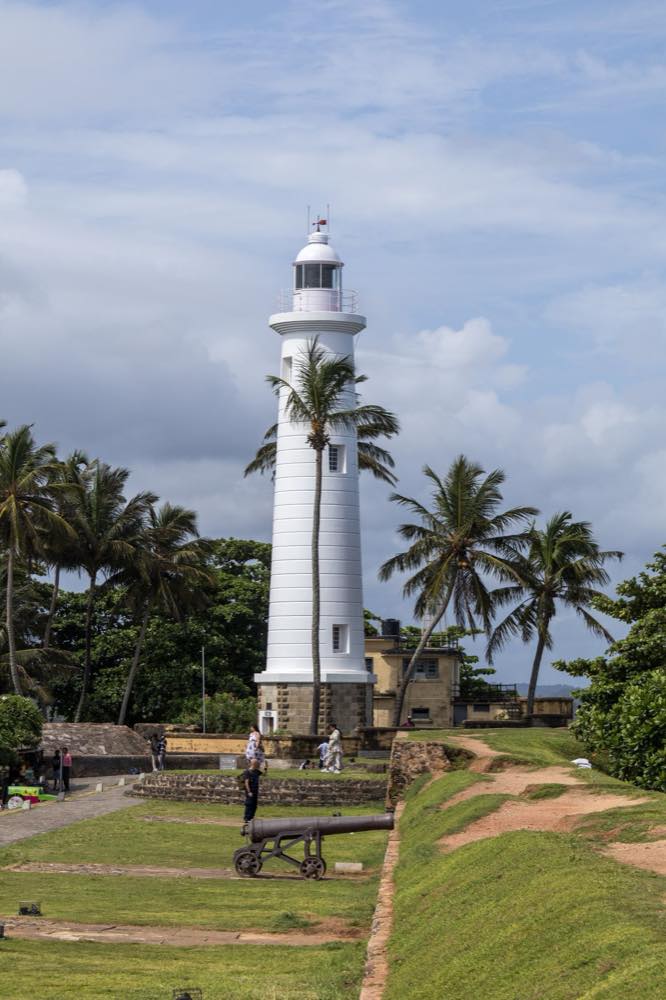 The lighthouse and cannon on the south-western bastion.
At Flag Rock Bastion you may see local young men performing the traditional cliff dive into the sea for tips. Do not pay anyone before they jump, and treat it as a show you tip afterwards if you enjoyed it. Arrive by about 5:15pm for a spot on the wall, because sunset (around 6pm year-round, as Sri Lanka is near the equator) draws the Fort’s biggest crowd. The ramparts are not lit at night, so leave once the light fades.
Inside the walls: the streets and key buildings
Drop down from the wall into the grid after sunset, or earlier if the heat is heavy. These are the stops worth your time:
Old Dutch Hospital. One of the oldest buildings in the Fort, dating from the 17th century, restored in the early 2000s and now an open courtyard of cafes, restaurants and shops. The long colonnaded frontage keeps the original Dutch roofline. Walk through even if you do not eat.
Dutch Reformed Church (Groote Kerk). Built in 1755 on Church Street, this is among the oldest Protestant churches in Sri Lanka. The floor is paved with VOC-era tombstones, and the interior is plain whitewash and dark wood. It is open during the day with no fixed charge, but a donation is the polite norm.
All Saints’ Church. A smaller Anglican church on Lighthouse Street with a garden behind. A brief stop if you are passing.
National Maritime Museum. In a former Dutch warehouse near the main gate, covering Indian Ocean trade, local fishing craft and finds from regional shipwrecks. Expect a modest fee for foreign visitors.
Meeran Mosque. The white mosque near the clock tower, a reminder that the Fort has long been home to a Muslim community. Dress modestly and ask before entering.
The side streets. Pedlar Street, Church Street and Hospital Street hold the boutiques, gem shops and old Dutch houses with their deep verandas. Lanes are quieter between 1pm and 3pm, when many shops close.
Suggested 3-hour route
- 4:00pm Enter by the main gate, see the clock tower, climb to the wall at the Star Bastion.
- 4:20pm Walk clockwise along the southern wall past Moon and Sun Bastions.
- 5:00pm Reach Point Utrecht Bastion and the lighthouse, then move on to Flag Rock Bastion by 5:15pm.
- 6:00pm Sunset on the wall.
- 6:30pm Descend to the Dutch Reformed Church exterior and Old Dutch Hospital for dinner.
For a quieter morning version, reverse the order: start at 6:30am, do the loop in cool light, and finish at a Church Street cafe before the day-trippers arrive. See our Galle restaurant guide for where to eat afterwards.
Walking tour or self-guided?
The walls are easy to do alone, but the buildings reward a guide. A guided session adds the story of the Portuguese, Dutch and British periods, the fort’s survival of the 2004 tsunami (the thick walls shielded much of the old town) and the hidden courtyards you would otherwise pass. Browse Galle Fort tours and walking tours on GetYourGuide, or compare options in our best tours in Galle roundup. Many guides offer sunset-timed walks.
Practical tips
- Dress: Light clothing, but cover shoulders and knees for churches and the mosque.
- Sun: The walls are exposed. Midday walking is hot, so avoid 11am to 3pm.
- Getting here: Galle is about 2 hours from Colombo by the Southern Expressway, or 2.5 to 3 hours by the coastal train. Tuk-tuks drop at the gate and the Fort itself is entirely walkable.
- Staying inside: Many visitors sleep within the walls to enjoy the quiet evenings. See where to stay in Galle or search Galle hotels.
- Cash: Carry small notes for donations, tips and museum entry.