Sri Lanka and South India - Tamil Nadu and Kerala combined - sit within 30 kilometres of each other at the Palk Strait. Culturally, linguistically, and historically they are deeply intertwined: Tamil is spoken on both sides, Hindu temples share architectural DNA, and the sea between them has been a trading lane for over two millennia. Yet for travellers deciding where to spend two or three weeks, the experiences diverge sharply. Here is how they compare across the things that matter most when planning a trip.
Cost of Travel
Sri Lanka daily budget: USD 35–55 per day for comfortable mid-range travel. A private room in a guesthouse in Ella or Mirissa runs approximately USD 25–40 per night. A tuk-tuk covering 15 km costs around USD 4–7. A sit-down meal at a local restaurant is USD 4–8; a full rice and curry lunch at a roadside kade starts from USD 1.50. National park entry fees add up quickly - Yala charges USD 15 entry plus USD 30 for the mandatory jeep safari.
South India daily budget: USD 25–45 per day for similar comfort. A private room in a mid-range guesthouse in Kochi or Madurai runs USD 20–35 per night. Meals are cheaper - a full thali in Tamil Nadu costs USD 2–4, and a Kerala sadya (banana-leaf feast) at a local restaurant is USD 3–5. State-run buses between cities are extremely cheap (Chennai to Madurai, 450 km, around USD 4–8 by AC bus). Auto-rickshaw fares for short city hops cost USD 1–3.
Verdict: South India has the edge for budget travellers, primarily because of cheaper food and public transport. Sri Lanka is better value for time-poor travellers who want to cover ground quickly - shorter distances mean the higher per-km transport cost is still manageable overall.
Weather and Best Time to Visit
Sri Lanka has two monsoon seasons affecting different coasts. The south-west coast (Mirissa, Unawatuna, Hikkaduwa) and hill country are best from December to March; the east coast (Arugam Bay, Trincomalee) peaks from May to September. The cultural triangle in the north-central interior is broadly year-round, with March to May and September to October the most comfortable.
South India follows a different rhythm. Tamil Nadu’s Coromandel Coast (Chennai, Mahabalipuram) is best from November to February. Kerala is lovely from October to March - the backwaters and beaches of Alleppey and Varkala are at their finest then. The Kerala monsoon (June to September) is a draw in itself for some travellers: Ayurveda treatments are considered most effective during this period, and the landscape is spectacular.
Verdict: Both destinations are genuinely year-round if you know which region to target. Travellers combining the two work best visiting South India October–November before moving to Sri Lanka’s south-west for December–March. This sequence avoids both regions’ main monsoon periods.
Beaches
Sri Lanka punches above its weight for beaches given its small size. The south coast - Mirissa, Tangalle, Hiriketiya - offers excellent snorkelling, whale watching from November to April (blue whales at Mirissa are a genuine world-class experience), and relaxed beach towns without the crowds of Thailand. The east coast around Arugam Bay is one of Asia’s best surf spots.
Kerala’s beaches at Varkala (dramatic clifftop setting above red laterite cliffs) and Kovalam are solid but have been well-trampled by package tourism. The coastline north of Kochi is appealing but underdeveloped. Tamil Nadu’s beaches are largely unattractive for swimming - Chennai’s Marina Beach is famous but heavily polluted.
Verdict: Sri Lanka wins on beaches, and it is not particularly close. Mirissa, Tangalle, and Arugam Bay outclass anything in Tamil Nadu and most of Kerala’s offerings. Varkala is charming, but Sri Lanka’s beach circuit is significantly stronger.
For a detailed comparison of Sri Lanka’s beaches against Varkala and Kovalam specifically - including the houseboat backwater experience that Kerala does uniquely well - see Sri Lanka vs Kerala.
Food
Sri Lanka’s food centres on rice and curry - typically a mound of red or white rice surrounded by five or six curried vegetables, a dhal, a coconut sambol, and usually a protein. Hoppers (bowl-shaped fermented rice pancakes) and string hoppers (steamed rice noodles) are breakfast staples. Kottu roti - chopped roti stir-fried with vegetables and egg on a flat iron griddle - is street food theatre as much as a meal. Seafood is excellent all along the coast.
South India offers one of the world’s great vegetarian food cultures. Tamil Nadu’s Chettinad cuisine, originating around Karaikudi, is among India’s most complex: pepper-heavy gravies, kuzhi paniyaram (savoury dumplings), and rasam (tamarind pepper broth) are unlike anything in Sri Lanka. Kerala’s food absorbs Syrian Christian and Mappila Muslim influences - fish moilee (coconut milk fish curry), appam with stew, and prawn biryani in Kozhikode are distinct highlights. South India also has a serious coffee culture - filter kaapi in a steel tumbler is a ritual.
Verdict: Culinary depth goes to South India. The sheer regional variety across Tamil Nadu and Kerala is extraordinary, and vegetarians are exceptionally well served. Sri Lanka’s food is excellent but narrower in range.
For how Jaffna’s Tamil cuisine connects directly to Tamil Nadu’s Chettinad tradition - and why food travellers gain from experiencing both sides of the Palk Strait - see Sri Lanka vs Tamil Nadu.
Temples and History
Sri Lanka’s cultural core is the Cultural Triangle: Sigiriya (a 5th-century rock fortress 200 metres high, UNESCO listed, entry USD 35), Dambulla Cave Temples (cave complex with 150+ Buddha statues, entry USD 10), and Polonnaruwa (ancient royal capital, entry USD 25). The Temple of the Tooth in Kandy is the most sacred Buddhist site in the world and entry is USD 10. These sites are compact, well-preserved, and manageable in a 5–7 day loop.
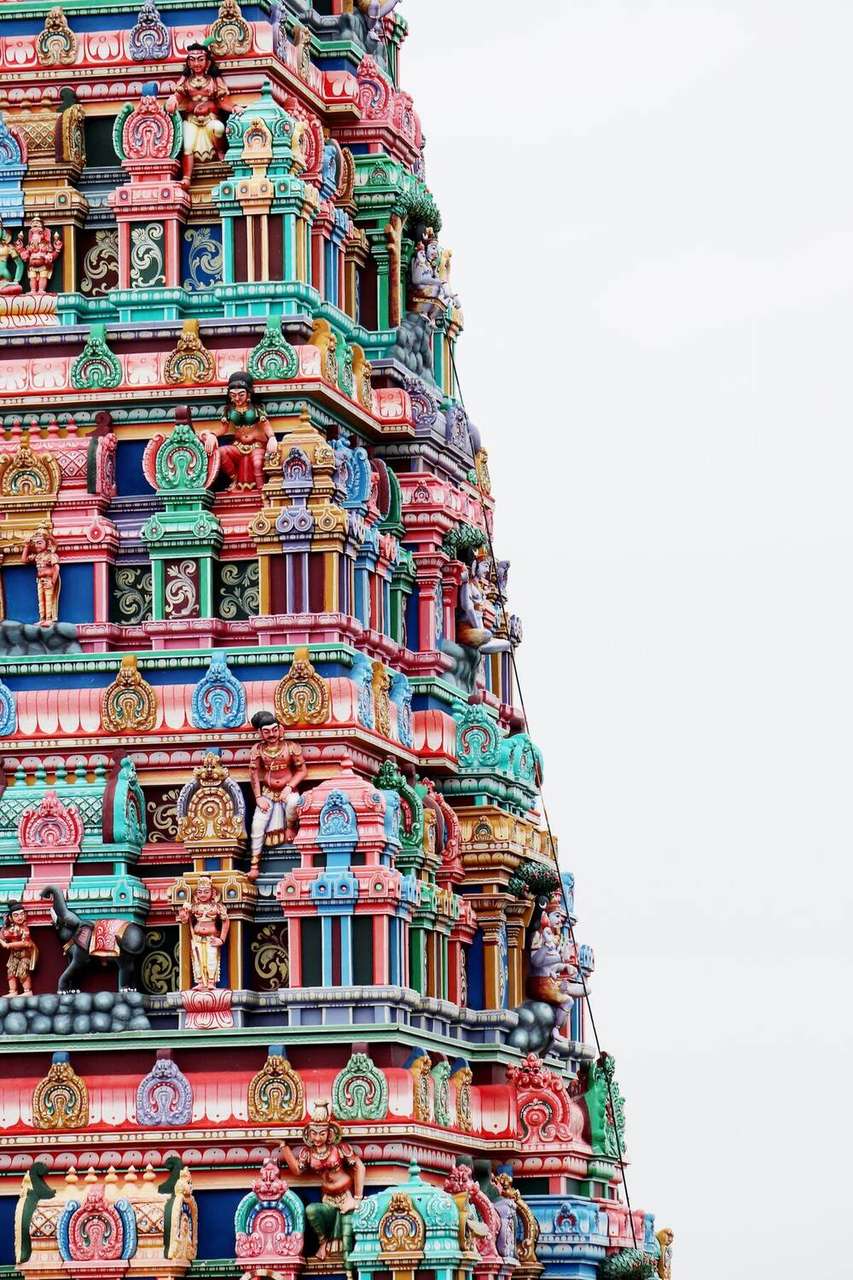
South India’s temple architecture is on an entirely different scale. Madurai’s Meenakshi Amman Temple has 14 gopurams (gateway towers) rising up to 52 metres, with an interior complex covering 6 hectares - it receives an estimated 15,000 visitors daily. Mahabalipuram’s shore temples and rock carvings (7th century, UNESCO listed) are among India’s finest. The Brihadeeswarar Temple in Thanjavur is a masterpiece of Chola architecture. Kerala’s Hindu temples are more modest in scale but deeply atmospheric - the Padmanabhaswamy Temple in Thiruvananthapuram is one of India’s wealthiest.
Verdict: For the sheer scale and continuity of Dravidian temple culture, South India is unmatched. Sri Lanka’s Cultural Triangle is more accessible and easier to cover thoroughly in a short trip, and Buddhist archaeology has its own character, but travellers who want to experience the grandest Hindu architecture in the world need to be in Tamil Nadu.
Wildlife and Nature
Sri Lanka is one of the world’s most wildlife-dense destinations for its size. Yala National Park has the world’s highest density of wild leopards. Minneriya and Kaudulla host the Gathering from July to October - hundreds of wild elephants at a single ancient reservoir. Blue whale watching off Mirissa (November to April) is world-class. Sinharaja Forest Reserve is a UNESCO-listed rainforest with dozens of endemic bird species.
South India has genuine wildlife highlights - Kerala’s Periyar Wildlife Sanctuary near Thekkady, with elephants viewed from a lake boat, is lovely. Mudumalai and Anamalai Tiger Reserves are serious wildlife parks with tigers, elephants, and leopards, though sightings are less predictable than Yala. The Nilgiri Hills and Western Ghats offer spectacular landscapes and birdwatching.
Verdict: Sri Lanka. Leopard sightings at Yala are among the most reliable in Asia, and the combination of safari, whale watching, and endemic birdwatching in a compact circuit is hard to match.
For a head-to-head of Yala and Udawalawe against Periyar and the Nilgiri reserves specifically, see Sri Lanka vs Kerala.
Ease of Travel
Sri Lanka is physically small (roughly 430 km north to south) and a circuit covering Colombo, the hill country, the south coast, and the Cultural Triangle is very manageable in two weeks. The train from Ella to Kandy is one of Asia’s most scenic rail journeys. Tuk-tuks and private drivers are easy to hire. English is widely spoken in tourist areas. The infrastructure, while not always smooth, is straightforward for independent travel.
South India’s scale is the challenge. Tamil Nadu alone is larger than England - travelling from Chennai to Madurai to Rameswaram to Kanyakumari and then into Kerala involves serious distances. State buses are cheap and frequent but slow. Trains are excellent value (book Indian Railways well in advance - popular routes sell out weeks ahead) but require navigation of the booking system. Language is more of a barrier in non-tourist areas; Tamil and Malayalam are linguistically distinct and very few locals outside tourist zones speak English.
Verdict: Sri Lanka is significantly easier to navigate independently, especially on a first visit to the region. South India rewards travellers who have more time and patience for logistics.
Visa Requirements
Sri Lanka ETA: USD 20, applied online at eta.gov.lk before travel. Valid 30 days on arrival, extendable by 30 days at the Department of Immigration in Colombo (USD 31 fee). Most passport holders are eligible.
India e-Visa: USD 25 for a standard 30-day tourist visa, or USD 40 for a 1-year multi-entry visa. Applied online through the Indian government portal. Processing typically takes 72 hours. Available to most nationalities with some exceptions.
Both are straightforward. India’s e-Visa form requires more information (sponsor details, previous India visits), but it is a routine online process. Neither country requires vaccinations for entry, though standard travel health precautions apply to both.
Who Each Destination Suits
Choose Sri Lanka if: you have two weeks or less and want to cover beaches, wildlife, and ancient history efficiently; you are a first-time visitor to the region and want manageable logistics; you prioritise wildlife and want reliable leopard and elephant sightings; or beaches are a primary draw.
Choose South India if: you have three weeks or more and want genuine cultural depth; Hindu temple architecture is a strong interest; vegetarian food matters a great deal to you; you want the Kerala backwaters experience; or you are combining with a broader India trip.
Combine both if: you have four or more weeks. The ferry crossing at Rameswaram–Talaimannar is slow and unreliable; budget for a 90-minute Chennai–Colombo flight (approximately USD 80–130 one-way with IndiGo, Air India, or SriLankan Airlines) and the combination flows very naturally. A logical itinerary: Chennai → Mahabalipuram → Madurai → Rameswaram → fly Colombo → Cultural Triangle → Kandy → south coast → Colombo out.
Final Verdict
Sri Lanka vs South India is not a competition with a single winner - it is a question of what kind of trip you want. Sri Lanka gives you maximum diversity in minimum time: a fortnight can cover rainforest, leopards, ancient Buddhist ruins, whale watching, and world-class beaches without once feeling rushed. South India gives you something harder to replicate: one of the oldest living civilisations on Earth, expressed in temple cities that dwarf almost anything in the Buddhist world, a food culture of extraordinary complexity, and backwater landscapes that have defined South Asian travel writing for decades.
If time is short, Sri Lanka wins on efficiency. If time is generous and curiosity runs deep, South India earns equal billing.
More Comparisons
- Sri Lanka vs India
- Sri Lanka vs Bali
- Sri Lanka vs Kerala
- Sri Lanka vs Maldives
- Sri Lanka vs Mauritius
- Sri Lanka vs Singapore
- Sri Lanka vs Tamil Nadu
- Sri Lanka vs Thailand
- Sri Lanka vs Vietnam
Plan Your Trip
Book before you go:
Suggested itineraries: