Separated by the shallow, 30-kilometre Palk Strait, Sri Lanka and Tamil Nadu have been entangled across two millennia of trade, migration, and war. Tamil is spoken on both sides of the water. The gopuram towers of Sri Lanka’s Jaffna and the great temples of Madurai share the same Dravidian architectural grammar. Yet for travellers, the experience of each destination diverges significantly. Here is how to think about the choice.
This guide covers the Tamil Nadu–Sri Lanka comparison in depth, with particular attention to Jaffna’s cultural ties and the Dravidian temple tradition. For a broader overview that also covers Kerala, backwaters, Ayurveda, and logistics across South India as a whole, see Sri Lanka vs South India.
The Cultural Connection
No comparison of Sri Lanka and Tamil Nadu makes sense without understanding how intertwined they are. Sri Lanka’s Tamil community - concentrated in Jaffna in the north and the hill country tea estates - shares language, cuisine, and Hindu religious traditions with Tamil Nadu’s population of approximately 80 million people. The Chola dynasty ruled both regions in the 10th and 11th centuries, and Chola temple architecture directly shaped the gopuram tradition you see today in both Jaffna’s Nallur Kandaswamy Kovil and Tamil Nadu’s great Madurai and Thanjavur complexes.
Jaffna in particular functions as a cultural bridge. The food, the kovil architecture, the spoken Tamil dialect, and the family networks of Jaffna’s residents connect them more closely to Ramanathapuram and Tirunelveli across the strait than to Colombo 400 km to the south. Understanding this connection enriches both destinations considerably.
Temples
Tamil Nadu holds the edge for monumental temple architecture anywhere in Asia. The Meenakshi Amman Temple at Madurai is a living city within a city - its 14 gopurams (gateway towers), the tallest reaching 52 metres, are encrusted with thousands of stucco deities painted in ochre, blue, and green. The inner sanctum around the goddess Meenakshi has been in continuous ritual use for over 1,500 years. Brihadeeswara Temple at Thanjavur, built by the Chola emperor Rajaraja I around 1010 CE, remains one of the finest examples of early medieval South Indian architecture: a 66-metre vimana (tower) built without using mortar.
Sri Lanka’s Hindu temples, particularly in Jaffna, are architecturally and ritually compelling. Nallur Kandaswamy Kovil’s annual chariot festival in July–August draws hundreds of thousands of devotees. The Munneswaram Kovil near Chilaw and the Katharagama Devalaya in the south are important pilgrimage centres drawing both Hindu Tamil and Buddhist Sinhalese worshippers - an unusual syncretic overlap.
Sri Lanka also has Buddhist monuments on a scale Tamil Nadu cannot match: the Ruwanwelisaya and Jetavanaramaya dagobas at Anuradhapura are among the largest brick structures ever built in the ancient world. The rock fortress of Sigiriya (5th century CE) has no direct parallel in South India.
Verdict: For Dravidian Hindu temple culture specifically, Tamil Nadu wins. For the full breadth of ancient religious architecture - Hindu, Buddhist, and the syncretic overlap - Sri Lanka and Tamil Nadu together are unmatched in the region.
Food Culture
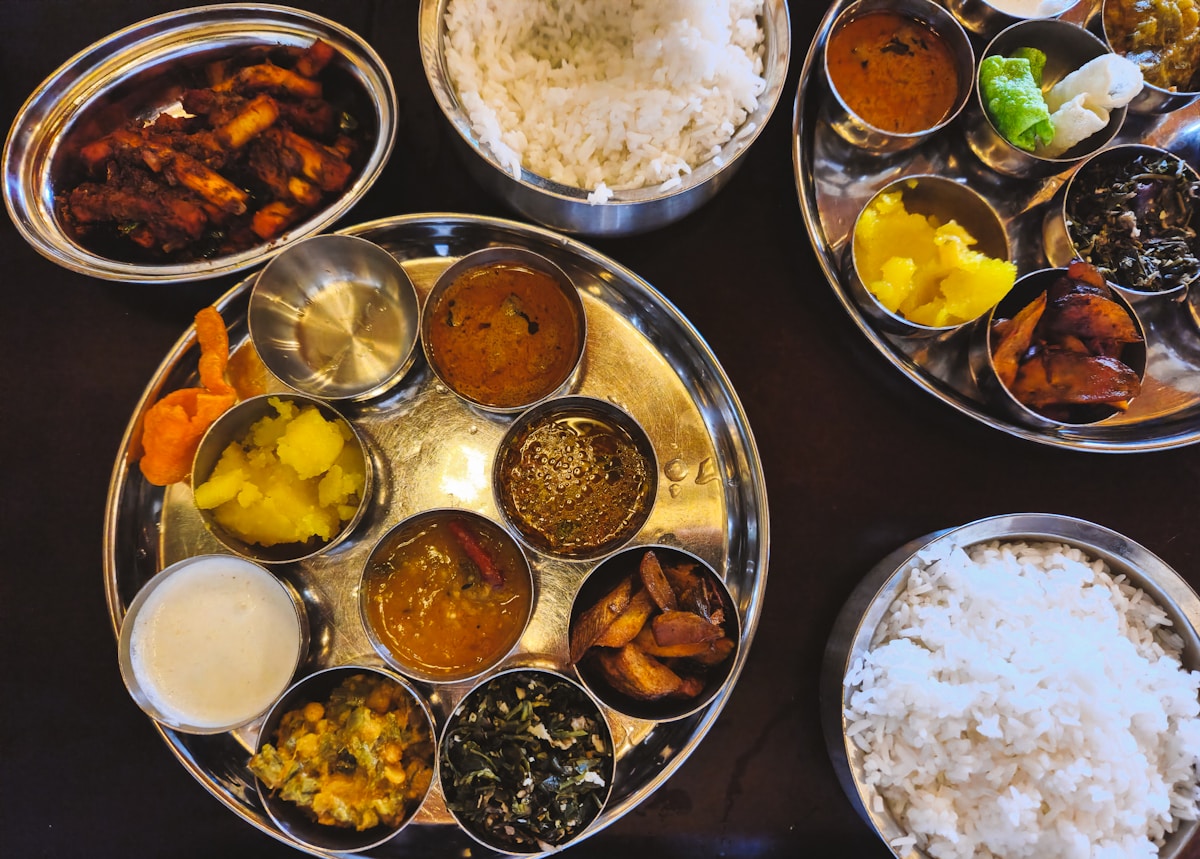
Tamil Nadu’s culinary identity is built on rice and legumes, cooked with extraordinary finesse. The classic Tamil breakfast - idli (steamed rice cakes) with sambar (a thin lentil and tamarind soup) and coconut chutney - is available from 06:00 at small tiffin shops across the state for under USD 1. Filter coffee, served in a steel tumbler poured between cup and saucer to create foam, is an institution. Chettinad cuisine, from the merchant class of the Chettiar community, is arguably the most complex and aromatic regional cooking in all of India: dishes use dried meats, stone-ground masalas, and spices such as kalpasi and marathi mokku that are rarely found elsewhere.
Jaffna’s cuisine is the Sri Lankan expression of this Tamil food culture. Jaffna crab curry - blue swimmer crabs cooked in a fiery red curry paste with coconut milk - is among the most celebrated dishes in Sri Lanka. Mutton rolls, vadai, and string hoppers with coconut milk gravy bridge the culinary gap between Jaffna and Tamil Nadu directly. Colombo and the south have their own distinct food identity - rice and curry, hoppers, kottu roti - which diverges considerably from the Tamil tradition.
Verdict: For Tamil food culture specifically, Jaffna and Tamil Nadu are complementary rather than competing. Travellers interested in South Indian culinary traditions benefit from experiencing both - Jaffna as a sea-crossing expression of Tamil food, and Tamil Nadu for the full breadth of tiffin culture, Chettinad cooking, and filter coffee.
For how Kerala’s Malabar and Syrian Christian food traditions compare - a different lens on South Indian cuisine entirely - see Sri Lanka vs Kerala.
Festivals: Pongal vs Esala Perahera
Pongal (January, typically 14–17 January) is Tamil Nadu’s most important festival - a four-day harvest celebration honouring the sun, with the ritual boiling of the first rice of the new harvest in clay pots until it overflows (a good omen). Cattle are decorated with painted horns and flower garlands. Tamil families across the state return home; the celebrations are domestic and community-level rather than a single spectacular public event. Jaffna’s Tamil community celebrates Pongal with equal enthusiasm - the festival connects Sri Lankan Tamils to their cultural homeland across the strait.
Kandy Esala Perahera (July–August, over ten nights in July and August, ending on the Nikini full moon) is Sri Lanka’s greatest spectacle. Over 100 decorated elephants, Kandyan dancers, whip crackers, fire jugglers, torch bearers, and monks process through Kandy’s streets for up to three hours each night. The Sacred Tooth Relic of the Buddha is carried by the Maligawa Tusker on the final nights. This is one of the largest and oldest Buddhist ceremonies in the world, with origins in the 4th century CE.
Verdict: Both are worth planning around if timing allows. Pongal is culturally significant but diffuse; Esala Perahera is a concentrated spectacle. Travellers with flexibility should target the Esala Perahera’s final three to four nights in Kandy.
Jaffna as a Cultural Bridge
Jaffna deserves special attention for travellers interested in Tamil culture. The 2009 end of the civil war and subsequent reconstruction have transformed Jaffna from an inaccessible conflict zone into one of Sri Lanka’s most rewarding and most culturally distinct destinations. The city is easily reached by train from Colombo (approximately six to seven hours) or by a short flight.
What makes Jaffna unique is how legibly it reads as a Tamil city within a South Asian Buddhist-majority island. The kovils are architecturally and ritually consistent with Tamil Nadu. The food - crab curry, Jaffna-style mutton, fresh palmyra toddy, wade - is closer to Tamil Nadu than to Colombo. The language is Tamil. The October Nallur festival turns the city into one of the most intense Hindu pilgrimage events in South Asia.
For travellers visiting both Sri Lanka and Tamil Nadu, Jaffna functions as a cultural hinge - easier to reach than Chennai or Madurai, yet offering a direct window into Tamil religious and culinary culture.
Cost of Travel
Sri Lanka: USD 35–55 per day for mid-range travel. Jaffna specifically is cheaper than the tourist south - guesthouses run USD 15–25 per night and the local food is extremely affordable.
Tamil Nadu: USD 25–45 per day. Chennai is moderately expensive by Indian standards; Madurai and Thanjavur run cheaper. The extensive state bus network makes inter-city travel remarkably cheap - Chennai to Madurai (450 km) by AC bus is approximately USD 5–8.
Verdict: Tamil Nadu is modestly cheaper overall, particularly for food and transport. Sri Lanka’s higher transport costs (per-km taxis are expensive) are offset somewhat by the shorter distances involved.
Beaches
Tamil Nadu’s coastline is largely unattractive for beach holidays. Chennai’s Marina Beach is famous for its six-kilometre length but is heavily polluted and not swimmable. Mahabalipuram (60 km south of Chennai) has an attractive beach adjacent to the Shore Temple, but the town is primarily a monument destination rather than a beach resort. Rameswaram Island, the closest Tamil Nadu point to Sri Lanka, has a spiritual rather than recreational draw.
Sri Lanka’s beaches - Mirissa, Tangalle, Hiriketiya, Arugam Bay - are strong enough to be a primary reason to visit, not an add-on. Whale watching off Mirissa from November to April (blue whales within a few kilometres of shore) is a world-class experience with no equivalent anywhere on the Tamil Nadu coast.
Verdict: Sri Lanka wins decisively on beaches. Travellers who want a beach holiday alongside temple culture should use Tamil Nadu for the temples and Sri Lanka for the coast.
Getting There and Getting Around
The most practical routing between Tamil Nadu and Sri Lanka is flying: Chennai to Colombo takes approximately 90 minutes and costs USD 80–150 one-way. A slower and more adventurous option is the Rameswaram to Talaimannar ferry, though services are infrequent and the crossing takes several hours - check current schedules as services have been intermittent.
Within Tamil Nadu, trains are the best way to travel between Chennai, Madurai, Thanjavur, and Kochi. Within Sri Lanka, the Colombo–Kandy–Ella train is one of the best rail journeys in Asia; buses cover the rest of the island efficiently.
Which Should You Choose?
Choose Tamil Nadu if Dravidian temple architecture is your primary interest - Madurai and Thanjavur are among the great temple experiences in Asia and have no real equivalent in Sri Lanka.
Choose Sri Lanka if you want beaches, wildlife (leopards at Yala, elephants at Udawalawe, blue whales off Mirissa), or the Buddhist heritage of Anuradhapura, Polonnaruwa, and Sigiriya.
Choose Jaffna if you want to experience Tamil culture within Sri Lanka - a genuinely distinctive destination that complements rather than duplicates a Tamil Nadu itinerary.
Choose both for four weeks or more. Sri Lanka’s compactness (most of the highlights fit into two to three weeks) makes it easy to pair with a Tamil Nadu circuit. The cultural continuity between Jaffna, Tamil Nadu, and the Dravidian Hindu world makes the combination more coherent than most dual-country trips.
More Comparisons
- Sri Lanka vs India
- Sri Lanka vs Bali
- Sri Lanka vs Kerala
- Sri Lanka vs Maldives
- Sri Lanka vs Mauritius
- Sri Lanka vs Singapore
- Sri Lanka vs South India
- Sri Lanka vs Thailand
- Sri Lanka vs Vietnam
Plan Your Trip
Book before you go:
Suggested itineraries: