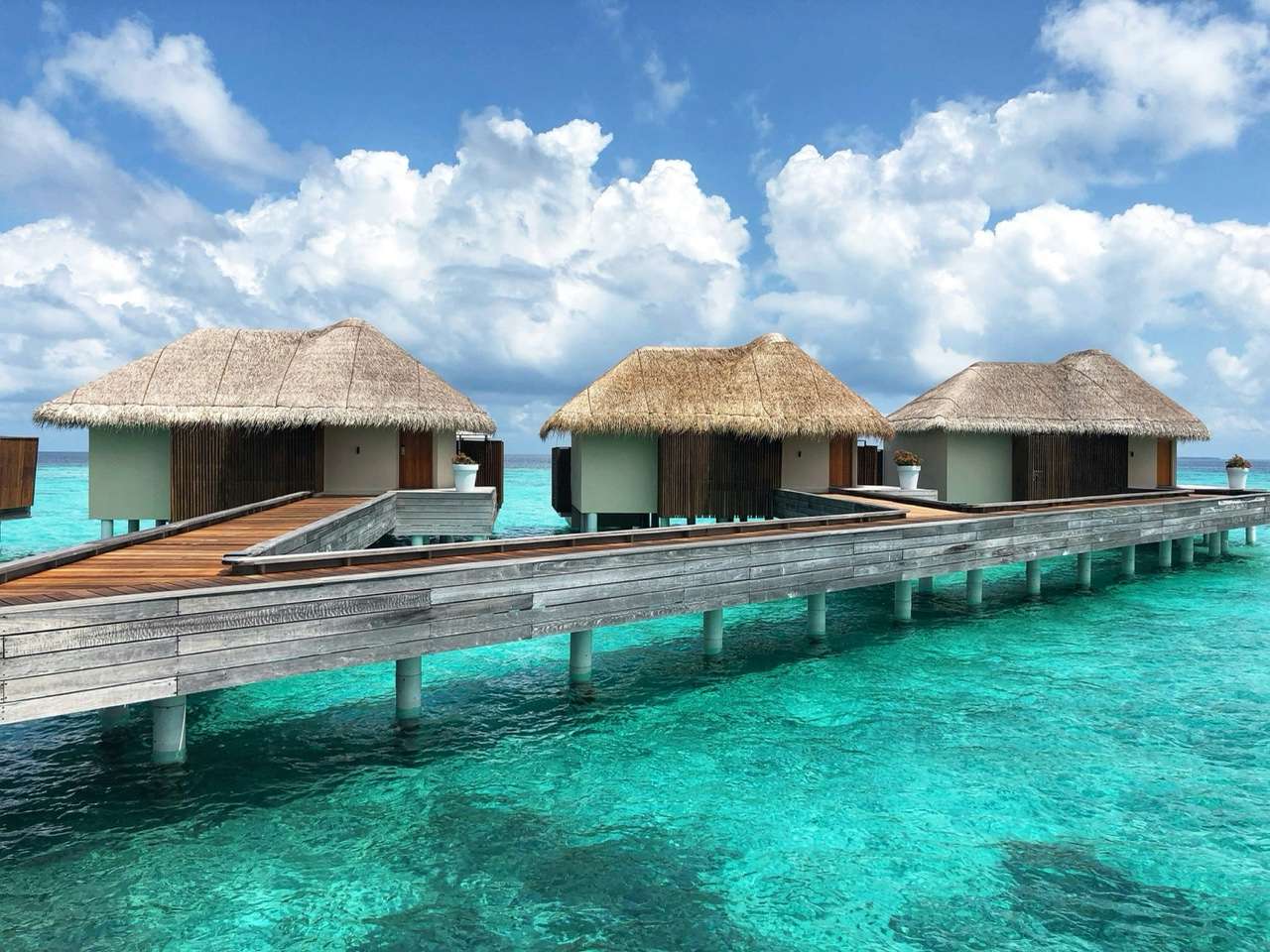
Sri Lanka and the Maldives sit in the same ocean and attract some of the same types of travellers - but they are fundamentally different kinds of destination. Sri Lanka is a large, complex country with ancient cities, highland tea estates, one of the world’s densest leopard populations, and a sophisticated cuisine that has been developing for millennia. The Maldives is 26 coral atolls spread across 900 km of Indian Ocean, built almost entirely around one experience: luxury isolation over turquoise water.
Understanding what each does best makes the choice straightforward.
Cost
Sri Lanka is accessible at almost every price point. Budget travellers spend USD 30–45 per day - a guesthouse in Ella or Mirissa costs USD 20–40 per night, a rice and curry lunch at a local restaurant is USD 2–5, and a tuk-tuk covers most short journeys for under USD 3. Mid-range accommodation throughout the hill country and south coast runs USD 45–100 per night. Even safari jeep hire at Yala National Park - approximately USD 60–90 per vehicle including entry - is affordable relative to comparable wildlife experiences elsewhere.
The Maldives operates almost entirely at the opposite end of the spectrum. The cheapest legitimate Maldives experience - staying in a local guesthouse on one of the inhabited islands (Maafushi is the most popular) - costs approximately USD 50–100 per night for a basic room. Mid-range resorts cost USD 200–400 per night. Overwater bungalows at established resorts start around USD 500 per night and regularly exceed USD 1,500 at the top end. Food and drinks are served primarily through the resort - there are no local restaurants within walking distance at most atolls - and at resort prices.
Verdict: Sri Lanka wins decisively on value and price flexibility. The Maldives has an extraordinary product, but it is a luxury and premium experience by design. Budget and mid-range travellers will spend the same money in two weeks in Sri Lanka as in three or four nights in the Maldives.
Beaches and Snorkelling
Sri Lanka’s south coast offers genuinely excellent beaches that are comparatively uncrowded outside peak season (December–March). Hiriketiya is a horseshoe bay with calm water on one side and a surf break on the other - ideal for a mixed group. Mirissa has Sri Lanka’s most famous stretch of sand alongside whale watching from November to April. Tangalle offers wide, frequently empty beaches backed by coastal lagoons. The east coast at Trincomalee and Pasikuda adds some of Sri Lanka’s clearest water.
Snorkelling quality is reasonable - Hikkaduwa has accessible reef snorkelling with sea turtles and reef fish within swimming distance of shore - but visibility and coral coverage do not approach what the Maldives offers consistently.
The Maldives is built for water. The house reefs surrounding most resort islands offer some of the world’s best snorkelling from the shore - visibility of 20–30 metres, healthy hard coral structures, and diverse marine life including reef sharks, rays, turtles, and vibrant reef fish. Many atolls are within range of whale shark aggregations (South Ari Atoll is particularly reliable, May–December). Manta ray encounters are common around Baa Atoll and Hanifaru Bay (a UNESCO Biosphere Reserve). Diving depth and variety here genuinely rank among the best in the world.
Verdict: Maldives wins for snorkelling, diving, and overwater beach aesthetics. Sri Lanka’s beaches are beautiful by most standards but are not competing with pristine atoll lagoons for underwater visibility and marine life density.
Wildlife
This is where Sri Lanka has no real competition from the Maldives. Yala National Park holds one of the highest densities of leopards relative to habitat of any national park on Earth. Udawalawe National Park reliably delivers close-range elephant encounters. Minneriya and Kaudulla host the Gathering - hundreds of wild elephants converging around ancient reservoir tanks from July to October - one of Asia’s most dramatic wildlife spectacles. Blue whales surface a few kilometres off Mirissa from November to April; these are among the largest animals on Earth, viewable at close range.
Sloth bears roam Wilpattu. Sri Lanka has a high density of endemic bird species concentrated in the Sinharaja rain forest. Saltwater crocodiles inhabit coastal lagoons near Kalpitiya. The country’s wildlife offer, packed into an island slightly smaller than Ireland, is exceptional by global standards.
The Maldives wildlife offering is confined almost entirely to the marine environment. Whale sharks, manta rays, reef sharks, dolphins, and sea turtles are regularly encountered. Above the waterline there is almost nothing - no mammals, no large birds, minimal landscape diversity.
Verdict: Sri Lanka wins comprehensively. The Maldives is one of the world’s great diving destinations, but for anyone who values land-based wildlife, the comparison is not close.
Culture and History
Sri Lanka’s cultural depth is one of its most underrated assets. Anuradhapura and Polonnaruwa contain some of Asia’s earliest Buddhist monuments - dagobas, temple complexes, and irrigation systems dating back more than 2,000 years. Sigiriya is a 5th-century rock fortress rising 200 metres above the jungle canopy, decorated with ancient frescoes and surrounded by sophisticated water gardens. The Temple of the Tooth Relic in Kandy is one of Buddhism’s most important pilgrimage sites. Daily temple rituals, Esala Perahera (Kandy’s great annual procession), and the distinct cultural influences of Sinhala, Tamil, Muslim, and Burgher communities give Sri Lanka genuine cultural texture.
The Maldives has a distinct Islamic culture shaped by centuries of Indian Ocean trade, but the infrastructure for engaging with it as a visitor is limited. Most guests stay at full-board resorts on uninhabited islands with no access to Maldivian towns, mosques, or daily life. Local island tourism (Maafushi, Thulusdhoo) gives limited access to the inhabited Maldives, but the cultural experience remains thin compared to most South Asian destinations.
Verdict: Sri Lanka wins clearly. The Maldives is not a cultural travel destination in any meaningful sense; the experience is almost entirely beach and ocean focused. Travellers who want history, living religious culture, and architectural heritage should be in Sri Lanka.
Landscape and Inland Exploration
Sri Lanka’s interior is as compelling as its coast. The hill country - accessible by train from Kandy to Ella on one of the world’s most celebrated railway routes - passes through tea estates, misty valleys, waterfalls, and colonial-era stations at altitude. Nuwara Eliya sits at 1,868 metres and has a peculiar British hill-station atmosphere that contrasts sharply with the coastal lowlands. Horton Plains is a high-altitude plateau with a dramatic cliff edge called World’s End dropping 870 metres into the lowlands below.
The Maldives has no inland to speak of. The islands are coral atolls at sea level - the highest point in the country is approximately 2.4 metres above sea level - and the landscape consists entirely of beach, lagoon, and coconut palm. There is no hill country, no wildlife corridor, no ancient city to explore. The natural environment is almost entirely aquatic.
Verdict: Sri Lanka wins for landscape variety and inland exploration by a wide margin.
Accommodation
Sri Lanka has excellent accommodation across all price points. Heritage properties include Geoffrey Bawa’s iconic Bentota hotels, and boutique guesthouses throughout Galle’s Fort district, the hill country, and the south coast offer strong value in the USD 80–180 per night range. Luxury resorts include Aman’s Cape Weligama, the Fortress in Koggala, and several properties around Kandy. Negombo near the airport has a full range of mid-range hotels for convenient stopovers.
The Maldives’ accommodation is almost entirely resort-based, and overwater bungalows - rooms or villas built over the lagoon on stilts - are the signature product. The experience of stepping from a private deck directly into a clear lagoon is genuinely unique. There are roughly 100 inhabited islands with local guesthouses (the cheapest option), and around 100+ resort islands. The resort product is polished and highly designed, with strong brands including Soneva, Six Senses, Aman, and Four Seasons all operating here.
Verdict: The Maldives offers a unique accommodation experience that cannot be replicated elsewhere. Sri Lanka offers better value at every tier below luxury. For the overwater bungalow experience specifically, the Maldives has no real rival.
Which Should You Choose?
Choose Sri Lanka if you want: ancient Buddhist civilisation and UNESCO World Heritage sites, reliable large-mammal wildlife in a compact footprint, the hill country train journey from Kandy to Ella, whale watching from Mirissa, surfing at Arugam Bay, or genuine cultural immersion across multiple communities.
Choose the Maldives if you want: overwater bungalows with direct lagoon access, world-class snorkelling and diving on pristine house reefs, absolute beach isolation with no towns or roads, or a focused luxury honeymoon or anniversary trip with no agenda beyond the water.
Choose both if you have three weeks or more - this is one of the Indian Ocean’s classic pairings. Sri Lanka for wildlife, history, and highland scenery; the Maldives for three to five nights of deep decompression at the end. The contrast is a feature, not a problem.
Sri Lanka wins on cultural depth, wildlife, inland variety, and value. The Maldives wins on overwater luxury, snorkelling, and the completeness of its beach isolation - for that specific experience, it remains unmatched.
More Comparisons
- Sri Lanka vs India
- Sri Lanka vs Bali
- Sri Lanka vs Kerala
- Sri Lanka vs Mauritius
- Sri Lanka vs Singapore
- Sri Lanka vs South India
- Sri Lanka vs Tamil Nadu
- Sri Lanka vs Thailand
- Sri Lanka vs Vietnam
Plan Your Trip
Book before you go:
Suggested itineraries: